Rules
Defamation Law for Magazine Editors: A US Basics Guide
Defamation law for magazine editors sets who can sue, what a retraction must contain, which records to keep, and how to verify quotes. Here are the US basics.
What to take away
- A libel plaintiff must show a false statement of fact about them, published to a third party, that caused harm. Opinion and substantially true statements are not defamatory.
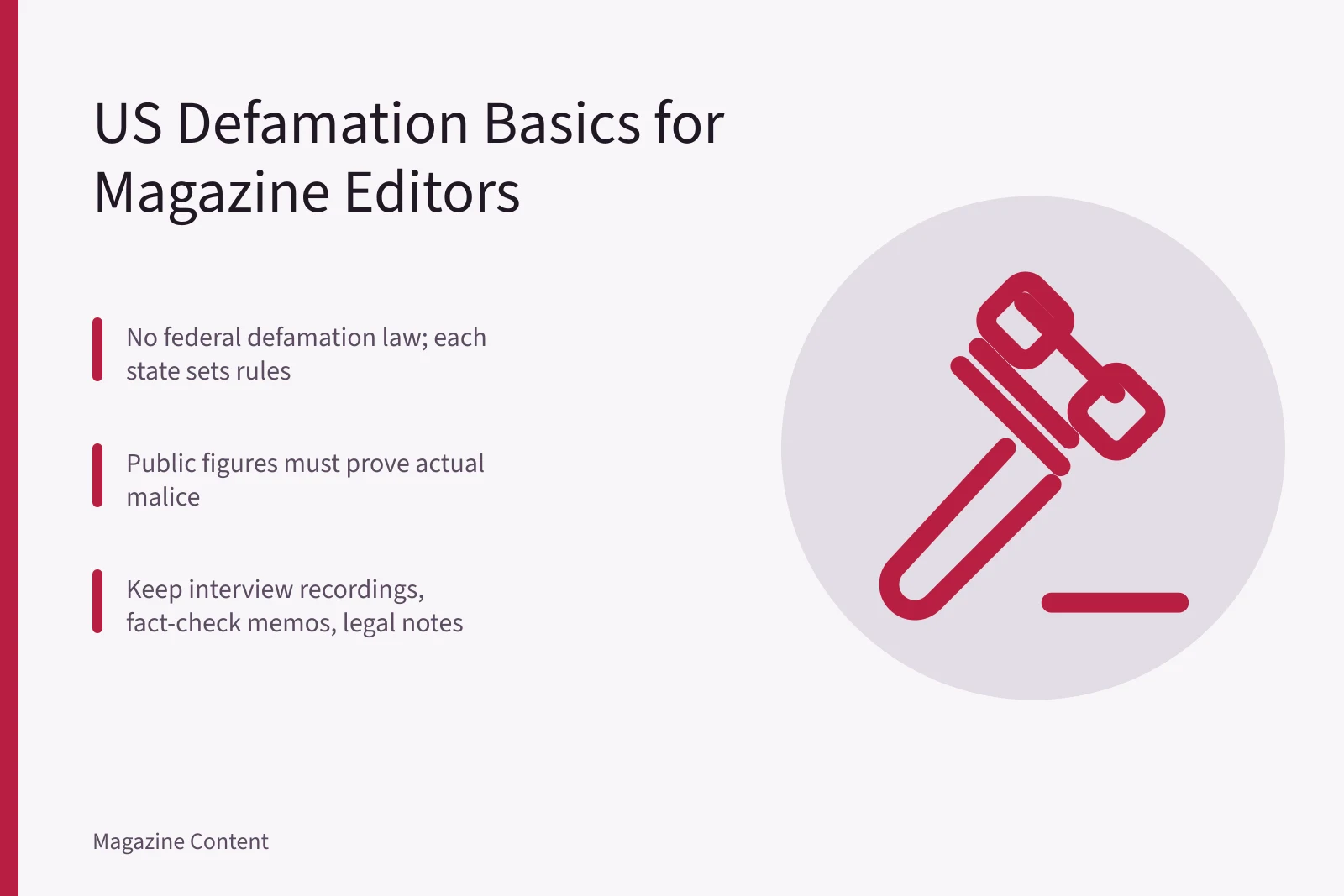
- Public officials and public figures must prove actual malice, meaning knowledge of falsity or reckless disregard for the truth. Private figures usually need only negligence.
- No federal defamation statute exists. Each state sets its own rules, including retraction statutes and deadlines that can run from one to three years.
- Keep the reporting file: notes, recordings, drafts, and fact-check memos. It is your evidence if actual malice is alleged.
- A correction is not a legal shield by itself, but several states reduce damages when a publisher retracts promptly and prominently.
Who has jurisdiction
Defamation is state law. There is no federal cause of action, so the courthouse that matters is usually where the plaintiff lives, where the magazine is published, or where copies circulated. A print run mailed into all fifty states can expose you in any of them.
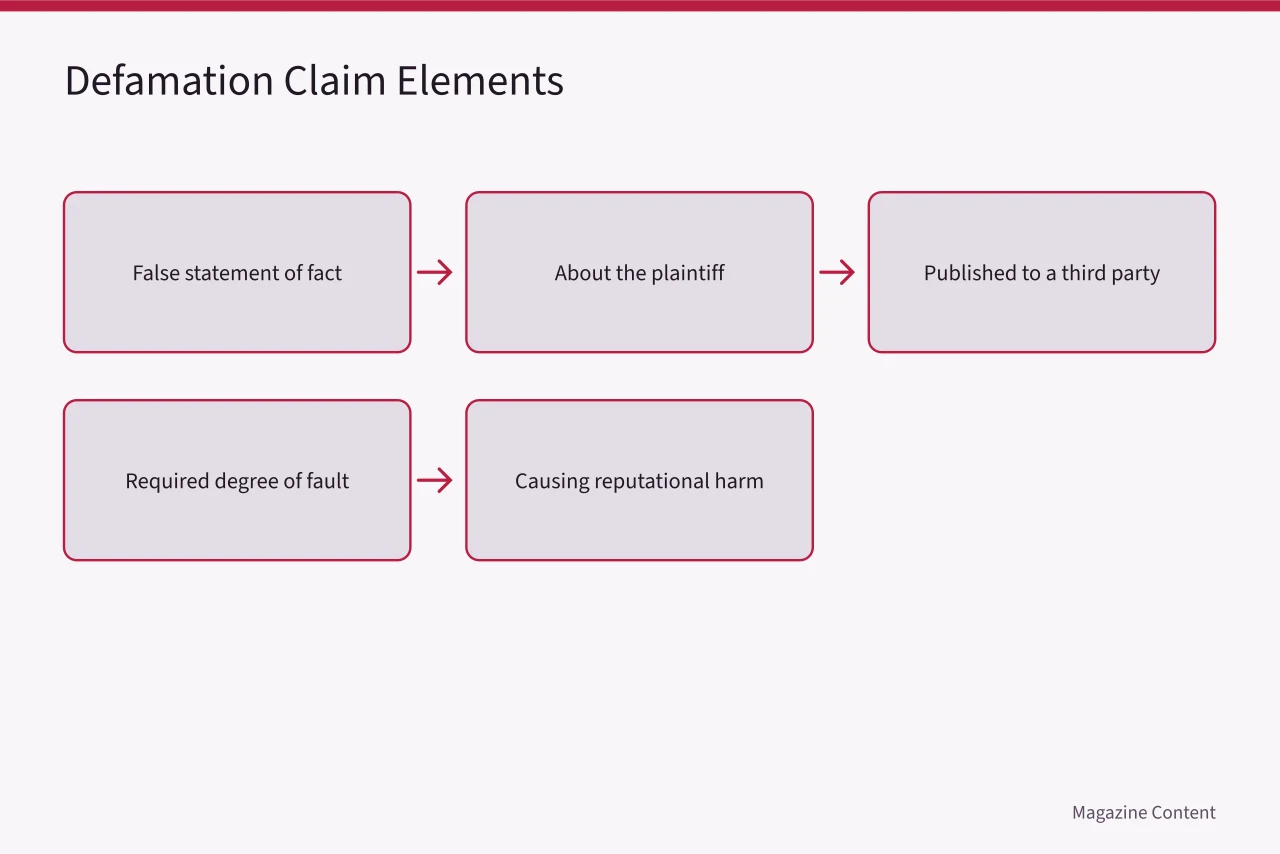
Most states follow the same basic elements, described by the Cornell Legal Information Institute: a false statement of fact, about the plaintiff, published to a third party, with the required degree of fault, causing reputational harm. The variation sits in the details, not the skeleton.
One detail is the statute of limitations. Single publication rules in most states start the clock at first publication and bar later suits over the same article, which is why a correction posted months later does not restart liability. Confirm your state's window before you assume a story is closed.
What must be disclosed
There is no filing requirement for a defamation claim, but there are disclosure duties that touch the same facts. If a story is sponsored, the Federal Trade Commission expects clear disclosure of the commercial relationship, as set out in its native advertising guide. Blur that line and a plaintiff can argue the audience read paid copy as independent reporting.
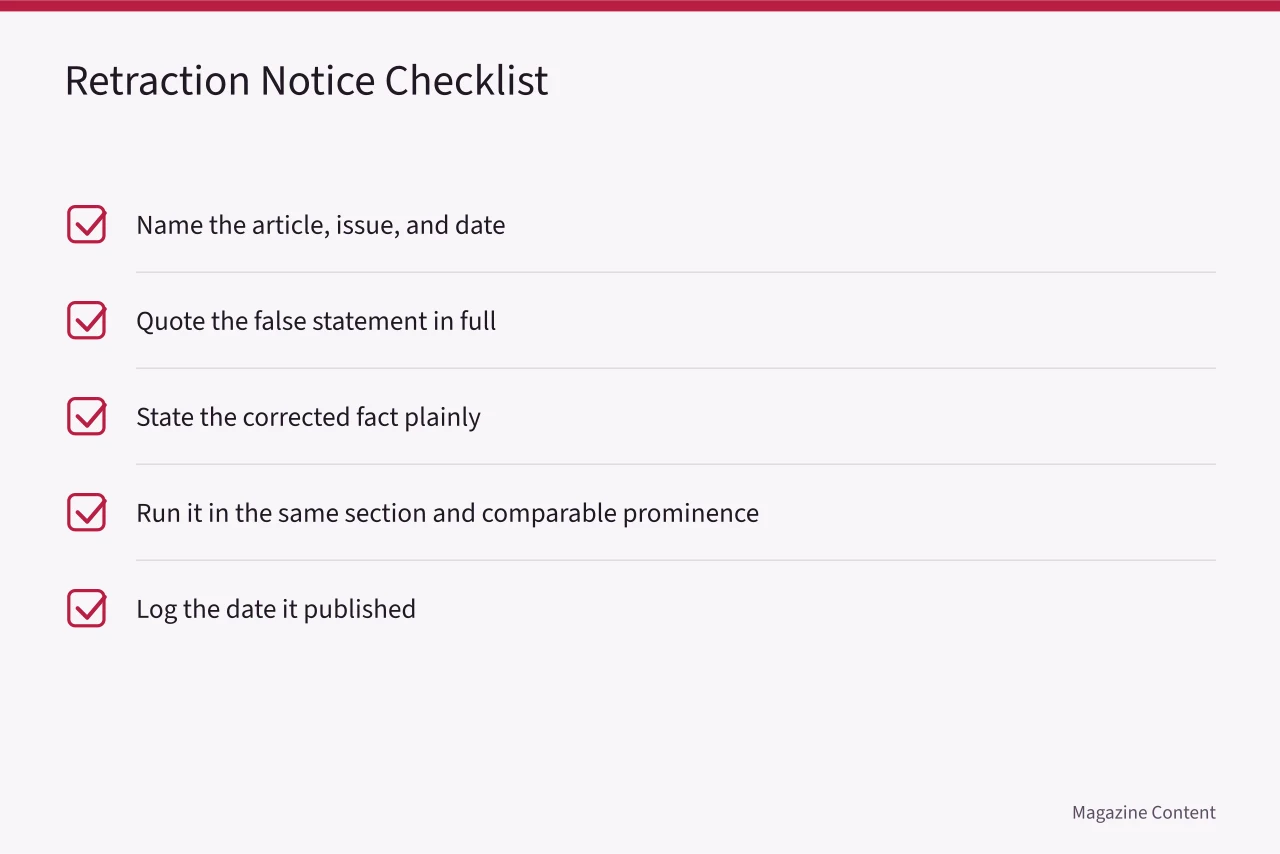
A compliant correction or retraction notice contains four things: the specific statement being withdrawn, the correct facts, the date and placement of the original, and a clear statement that the earlier version was wrong. Vague wording such as "errors were made" satisfies nobody and helps no defense.
- Name the article, issue, and date
- Quote the false statement in full
- State the corrected fact plainly
- Run it in the same section and comparable prominence
- Log the date it published
Records to keep
Your reporting file is the defense. Under the actual malice standard, a public figure plaintiff will subpoena your notes, emails, and drafts to look for doubt. Keep the material that shows what you knew and when.
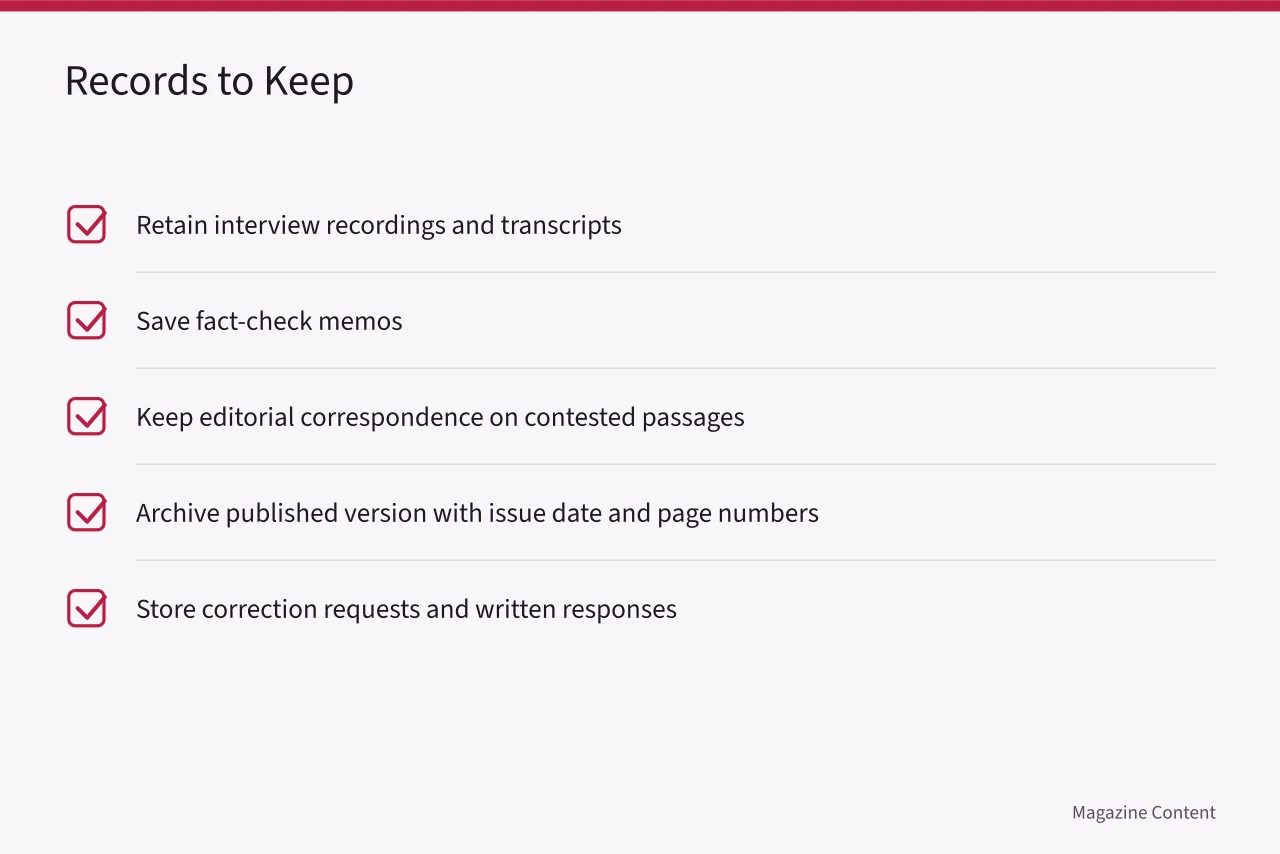
- Retain interview recordings and transcripts for at least the length of the longest applicable limitations period.
- Save fact-check memos that show which claims were verified and by whom.
- Keep the editorial correspondence around contested passages, including legal review notes.
- Archive the published version as it ran, with the issue date and page numbers.
- Store correction requests and your written response to each.
A records schedule beats good intentions. Check your state's limitations period and add a year of margin, then set a destruction date you actually follow.
What happens if you do not
The concrete consequence is money, and it is not small. A plaintiff who proves actual malice can recover presumed or punitive damages in many states, and those awards are not capped by the retraction statutes that limit compensatory damages. Defense costs alone can run into six figures before trial.
A missing fact-check memo does not create liability. It removes the evidence that would have defeated an actual malice claim.
There is also a practical cost that never reaches a courtroom. Sources stop returning calls once a magazine is known for loose verification, and that reputation travels faster than any correction.
Where the rules differ by place
State law splits in ways that matter to a national print run. Some states require a demand for retraction before a plaintiff can sue for certain damages. Others offer a retraction defense that caps recovery. A few have anti-SLAPP statutes that let a publisher dismiss a meritless suit early and recover fees.
Fault standards also shift. The Supreme Court set the public figure rule in 1964, and states apply it to different categories of plaintiffs. A local business owner suing over a profile may be treated as a private figure in one state and a limited-purpose public figure in another.
The opinion defense varies too. The fair comment privilege protects reviews and criticism in many states, but the protection depends on whether a reasonable reader would take the statement as fact or as judgment. A restaurant review calling a dish inedible is opinion. A claim that a restaurant reused spoiled meat is fact.
For a sense of how a single factual error travels through a magazine's production chain, the fact-checking case study walks through a claim that survived three edits. Editors who also handle mailing and distribution should review the USPS Periodicals permit guide, since circulation records can show where copies reached readers in a disputed state. Legal review belongs in the production schedule, not after the issue ships.
Common questions
Can we be sued for an opinion? Usually no, if a reasonable reader would take the statement as judgment rather than fact. Blending an opinion with a false factual assertion weakens the defense considerably.
Does a correction stop a lawsuit? Not always. It can reduce damages in states with retraction statutes, and it undercuts a claim of reckless disregard. It does not erase the original publication.
Who counts as a public figure? Elected officials and people who have voluntarily sought prominence on a public controversy. Courts apply the label narrowly, so most sources and subjects remain private figures.
Do we need a lawyer to read every issue? No. Most magazines use a libel read only for investigative pieces and profiles of named individuals. A written checklist for the rest is cheaper and faster.