Rules
USPS Periodicals Mail Permit: How to Apply and Save on Postage
USPS periodicals mailing permit lets magazines mail at publisher rates. Here is who applies, what gets disclosed, and what happens if you skip it.
What to take away
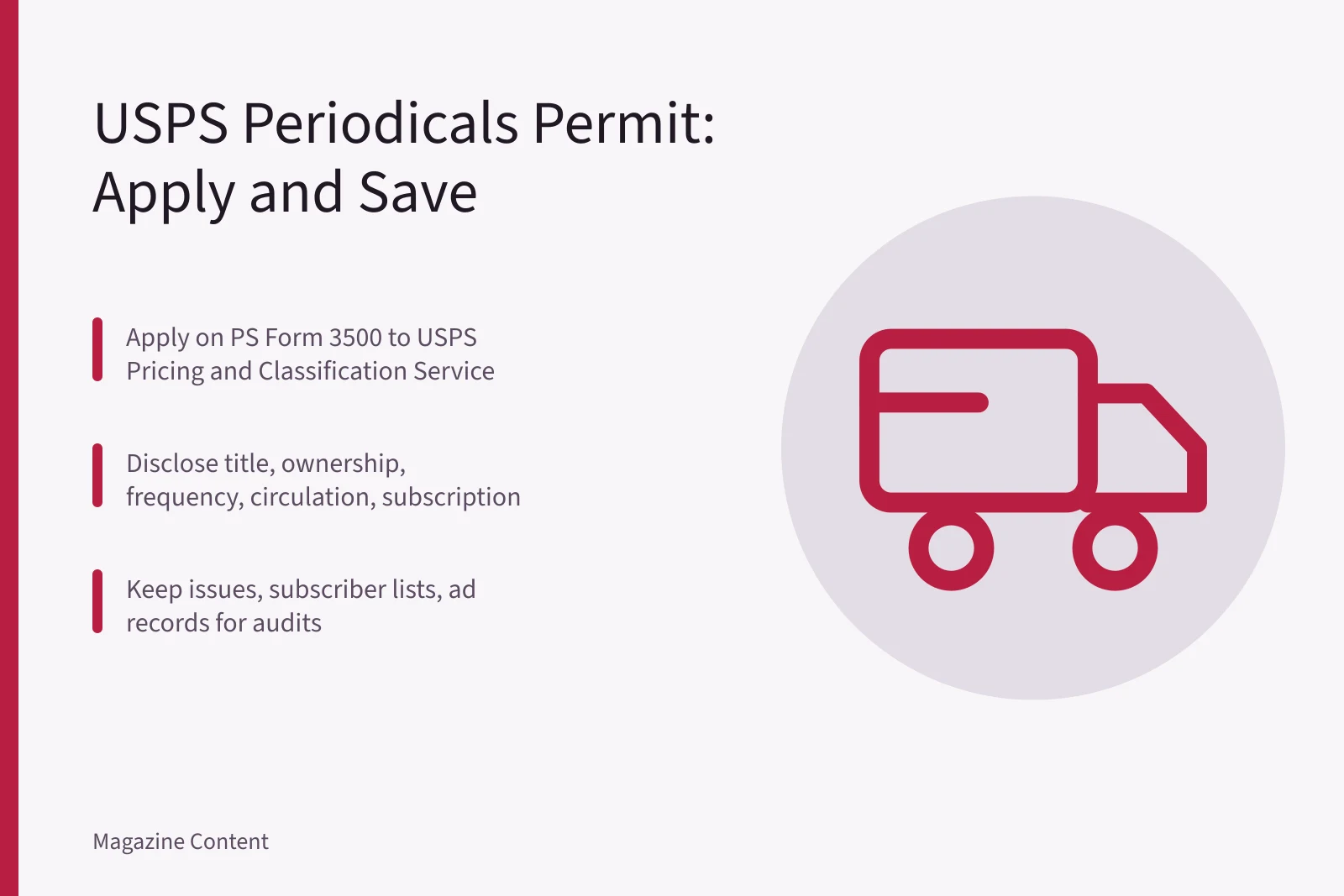
- The USPS is the regulator. Periodicals is a mail class for publishers only, and mailing at those rates requires an approved application on PS Form 3500.
- A compliant application discloses the publication's title, ownership, frequency, circulation and subscription price. Ownership disclosure is the part publishers most often get wrong.
- Records of circulation, subscriber lists and advertising content must be kept and produced on request. USPS can demand them.
- Mailing without authorization means you pay First-Class or Marketing Mail rates, or the mail is refused. The difference on a 10,000-piece issue runs into thousands of dollars.
- Rules differ by destination. Foreign mailing and Periodicals Outside County rates follow separate schedules.
Who has jurisdiction
The United States Postal Service administers the Periodicals mail class under Title 39 of the Code of Federal Regulations. The Domestic Mail Manual, usually cited as DMM 207, sets the eligibility tests. No state or city agency approves a periodicals permit; the application goes to the USPS Pricing and Classification Service Center that covers your mailing address.
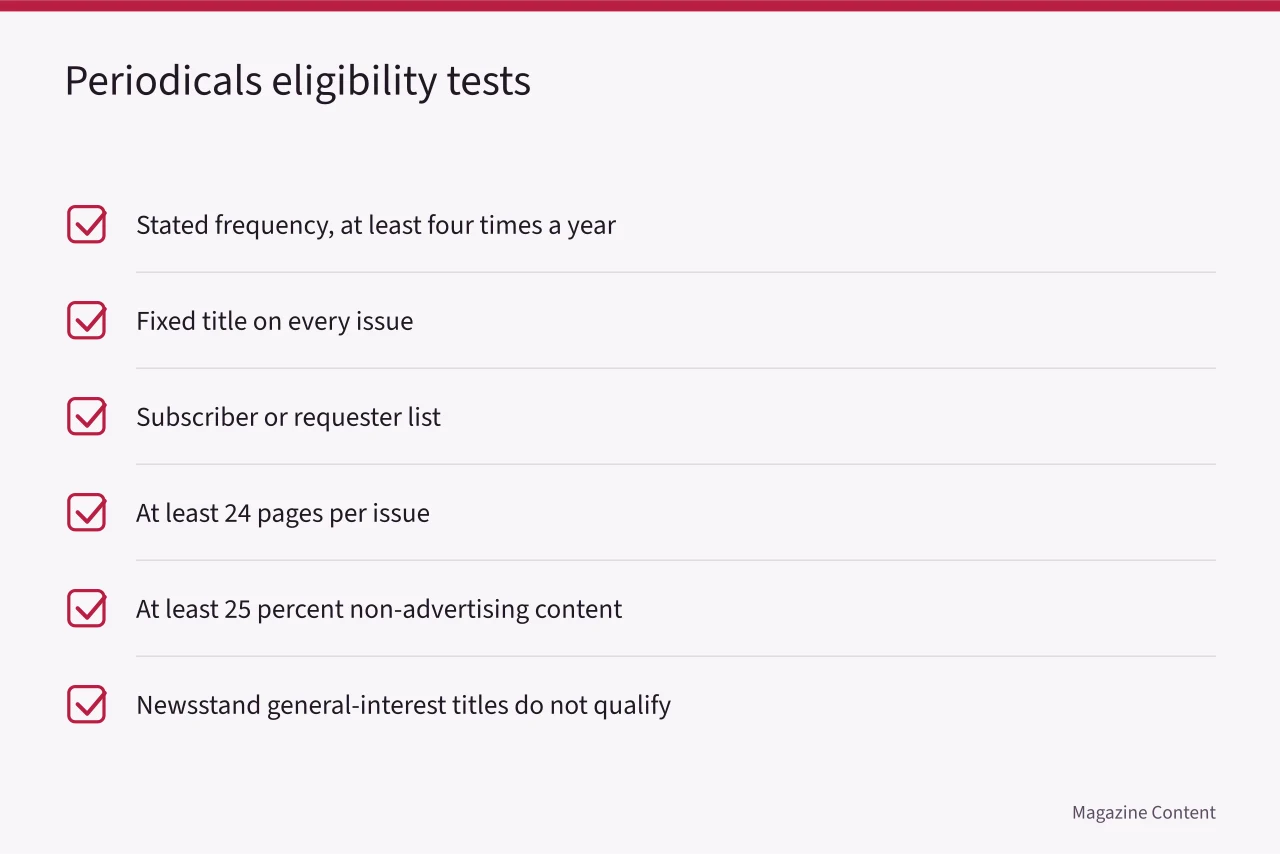
Eligibility is narrower than most new publishers expect. The publication must be a periodical, meaning it comes out at a stated frequency at least four times a year, carries a fixed title, and has a list of subscribers or requesters. It must contain at least 24 pages, at least 25 percent of which is non-advertising content. General-interest content sold on newsstands does not qualify; the publication needs a legitimate subscriber base or a documented request list.
The United States Postal Service publishes the current rates and forms, and the underlying class rules are summarised in the entry on Periodicals. Read both before you fill in anything.
What must be disclosed
PS Form 3500 asks for the publication's name, frequency, known office of publication, and the names and addresses of the owner, publisher and editor. Corporate applicants list officers and stockholders holding one percent or more. That ownership statement is not a formality. It is the same disclosure Congress wrote into the Postal Reorganization Act to stop covert control of periodicals.
A compliant application also carries a statement of circulation: how many copies are printed, how many are mailed to subscribers, how many are sold on newsstands, and how many are free or requested. The subscription price must be stated, and it must be a real price. A token price set to game the eligibility test invites rejection.
Records to keep
- Copies of every issue mailed under the permit, for at least one year
- Subscription records showing names, addresses and amounts paid
- The request list for free or controlled distribution, if you use one
- Advertising records that let you verify the non-advertising percentage
- The approved PS Form 3500 and any subsequent ownership updates
USPS may inspect these during a mail review or a periodicals audit. If the audit finds the publication no longer meets the eligibility tests, the permit can be revoked and back postage assessed.
What happens if you do not
The concrete consequence is money. Mail entered without a periodicals authorization is charged at the applicable First-Class Mail or USPS Marketing Mail rate. On a 10,000-piece issue, that gap is commonly several thousand dollars per mailing, and it applies retroactively if USPS decides you were never eligible.
There is a second consequence. Mailing at periodicals rates without an approved application, or continuing to mail after a revocation, can be treated as improper use of the mail. USPS can refuse the mailing at the dock, which means the issue does not reach subscribers on schedule. For a monthly title with advertising contracts tied to publication dates, a refused mailing is a commercial problem, not just a postal one.
Where the rules differ by place
Rates and entry points vary by destination and by how the mail is prepared. In-County Periodicals rates apply to copies delivered within the county of publication and are lower than Outside County rates. Sorted, barcoded, palletised mail earns automation discounts that unsorted mail does not.
Foreign destinations follow a separate schedule and a separate set of forms. Publishers mailing into Canada should note that Canadian funding programs work on entirely different criteria, as the Canada Periodical Fund page sets out. If your business model leans on subscription revenue, the subscription business model entry is a useful sanity check on pricing before you commit to a rate structure.
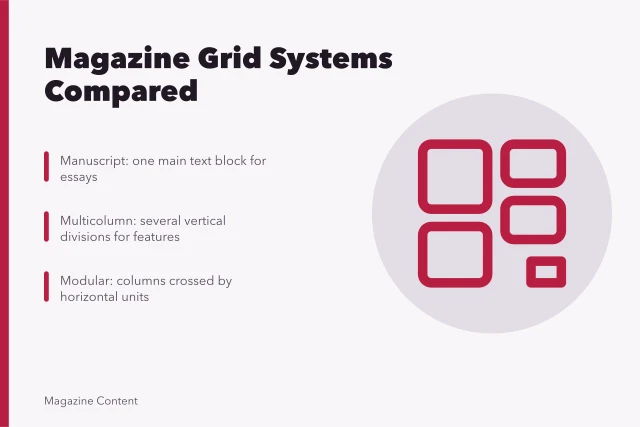
For the editorial side of the same operation, see how magazine grid systems compared affect page counts, because page count feeds directly into the 24-page eligibility floor. Publishers weighing a redesign should also read how to build a flexible magazine layout system before locking a trim size and page count. Distribution economics beyond the USPS are covered in how UK magazine distribution works, and the legal side of what you print sits alongside defamation law in the US.
Common questions
How long does approval take? The application is reviewed by the Pricing and Classification Service Center, and publishers commonly report several weeks to a few months. File well before your first mailing date.
Do I need a permit for every title? Yes. Each publication is authorised separately, even under the same ownership. A second title needs its own application and its own records.
Can I lose the permit? Yes. Failure to meet the frequency, page count or non-advertising percentage can lead to revocation, and back postage may be assessed on mail already sent.
Does a digital edition count? No. Periodicals eligibility is tied to the physical mailing. Digital editions are governed by separate rules and do not satisfy the subscriber test on their own.