Guides
Canadian Press Style for Magazines: CP or Chicago?
Canadian Press style for magazines decides spelling, measurements and names, while Chicago leaves those choices open. Here is how the two guides differ on the desk.
What to take away
- CP sets Canadian spelling, metric units and Canadian place names by default; Chicago sets punctuation, notes and citation.
- Most Canadian magazines run CP for news and Chicago for long features and book reviews.
- CP is a subscription service updated online; Chicago is a book you buy once and replace every few years.
- Neither guide settles house rules on hyphenation, serial commas or job titles. You write those yourself.
- Pick one as primary and name the other as a fallback, or copy editors will argue every page.
What is being compared
Two style guides sit on most Canadian magazine desks. The Canadian Press Stylebook is the news agency's own manual, sold by subscription and revised continuously. The Chicago Manual of Style is a reference book from the University of Chicago Press, now in its seventeenth edition, revised roughly every seven years.
They were built for different jobs. CP exists so wire copy reads the same in every newsroom. Chicago exists so scholarly and trade publishing can handle notes, bibliographies and complex typography. A magazine borrows from both, and the borrowing is where the arguments start.
The criteria that matter
| Criterion | Canadian Press Stylebook | Chicago Manual of Style |
|---|---|---|
| Spelling default | Canadian (colour, centre, licence) | US (color, center, license) |
| Measurements | Metric first, imperial in brackets | Author's choice, consistent |
| Place names | Canadian forms (Ottawa, Nunavut) | No national default |
| Punctuation | Lean, fewer commas | Serial comma, more marks |
| Citations | Rare, news style | Full notes and bibliography |
| Update cycle | Continuous, online | New edition every few years |
| Cost model | Annual subscription | One-time purchase |
Option by option
Canadian Press Stylebook
CP gives you Canadian English as the default, which matters for a title sold in provinces where readers notice "colour" and "licence." It handles Canadian institutions, federal titles and provincial names without a house list. It also assumes news copy: short sentences, metric units, minimal citation.
Chicago Manual of Style
Chicago gives you depth. Chapters on tables, captions, foreign languages and permissions run far beyond what CP covers. It is the better tool for a feature that quotes a court ruling or a book review with footnotes. Its spelling default is US, so you override it on every page.
A house guide built on both
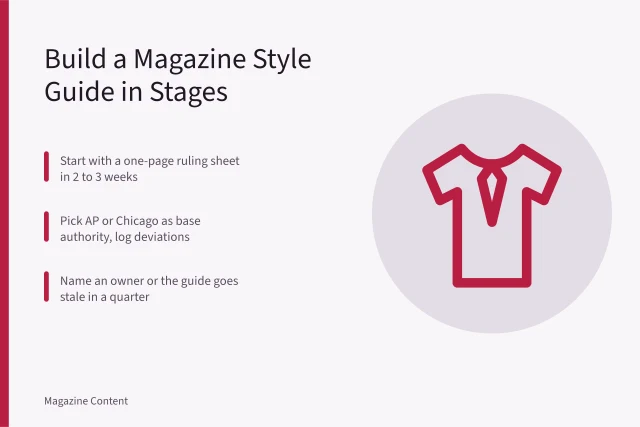
Most established titles do not choose. They write a short internal guide naming CP as primary for news and Chicago for features, then list the exceptions. That document is the one copy editors actually use. The method for writing it is set out in how to create a magazine editorial style guide, which walks through the sections a new title needs.
Where each one wins
CP is right for news-driven magazines: city weeklies, business titles, anything with short turnaround and Canadian datelines. If your copy arrives from freelancers across the country, CP's shared defaults cut editing time.
Chicago is right for features, arts criticism, academic-adjacent titles and any magazine running endnotes. A quarterly with long essays will use Chicago more than CP.
For layout and typography decisions that sit outside both guides, a working reference is magazine design, layout, and typography: a practical guide, which covers the grid and type choices style guides do not touch.
A style guide is a decision record. If two editors cannot settle a comma without opening the book, the guide is incomplete.
Example: one sentence, two guides
Take a line about a federal grant.
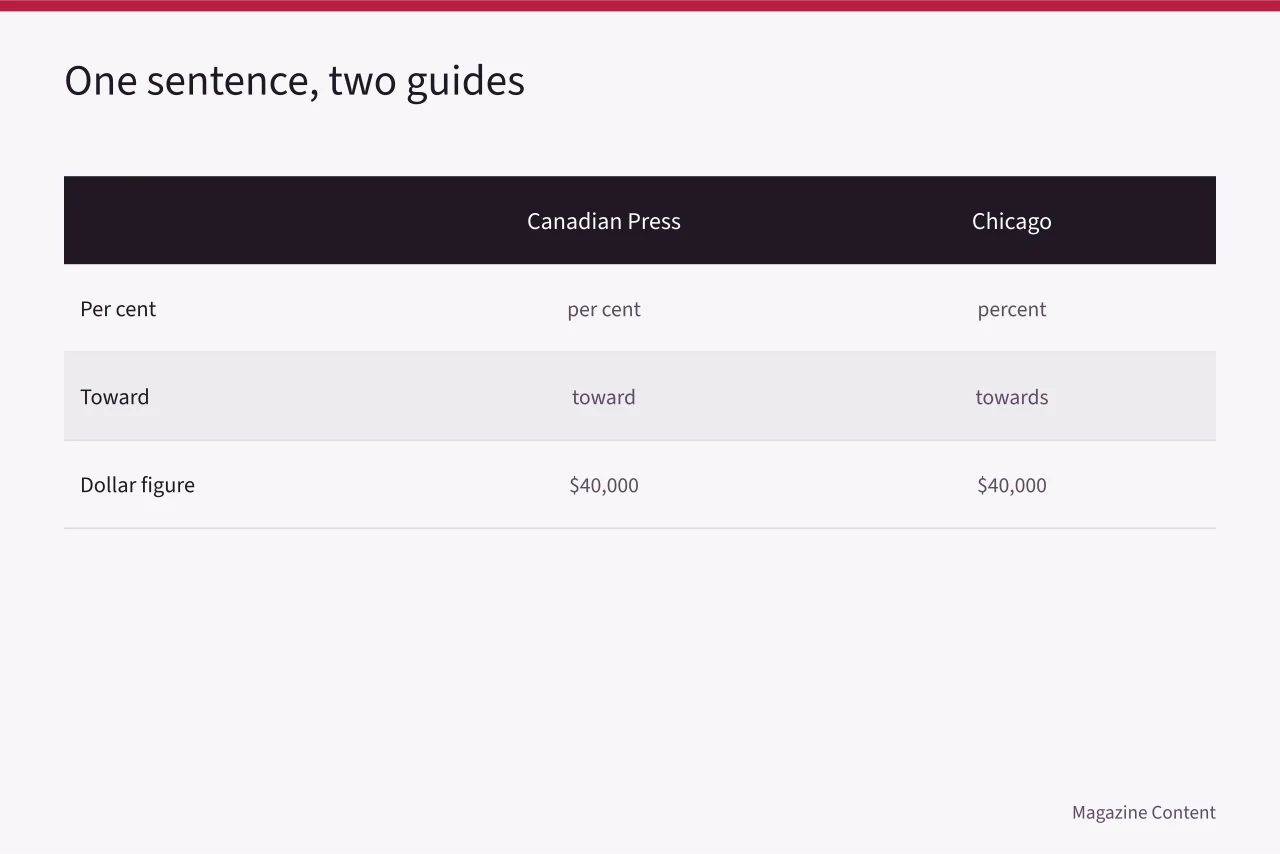
- CP form: The Canada Periodical Fund gave the magazine $40,000 in 2024.
- Chicago form: The Canada Periodical Fund gave the magazine $40,000 in 2024.
- The difference appears in the surrounding text: CP writes "per cent" as two words, Chicago writes "percent."
- CP prefers "toward," Chicago allows "towards."
- Both leave the dollar figure alone, so the number is never the argument.
The Canada Periodical Fund is a real program run by Canadian Heritage, and its eligibility rules matter more to a publisher than any comma. Details sit on the Canada Periodical Fund page.
Costs and upkeep
CP is a subscription, so the cost recurs every year and the book updates under you. Chicago is a purchase, so the cost lands once and the edition ages. Neither is expensive beside a print run, but the renewal is the line that surprises new publishers.
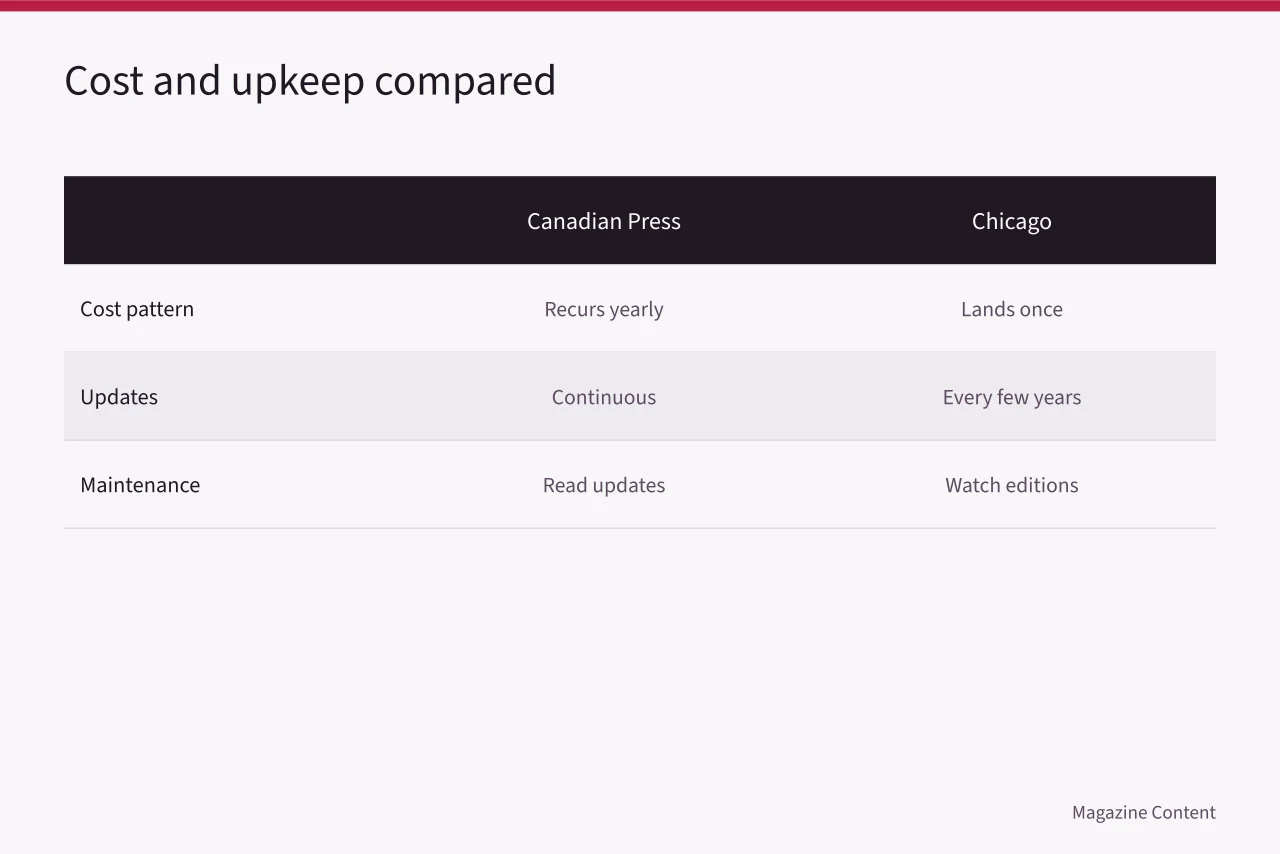
Budget the time, not just the money. Someone has to read the updates, tell the desk what changed, and amend the house guide. A guide nobody maintains is worse than no guide, because it makes old decisions look current.
For titles that also sell advertising, style intersects with disclosure rules. Sponsored pages need labels that meet truth-in-advertising standards, and the FTC native advertising guide explains what a reader must be told. A magazine's own style guide should say where that label sits on the page.
What none of them solve
Neither guide decides your voice. CP will not tell you whether to open a feature with a scene or a fact. Chicago will not tell you how long a caption should run.
Neither settles legal risk either. Defamation, fair comment and privacy are questions for a lawyer, not a stylebook, and a magazine that publishes profiles should keep counsel on call.
Both also assume a reader who already knows the rules. A new editor inheriting either guide still needs the house exceptions written down, or the first issue will read like three different magazines stitched together.
Common questions
Does Canadian Press use Canadian spelling?
Yes. CP follows Canadian English, so "colour," "centre" and "licence" are standard. Chicago defaults to US spelling, which is why Canadian magazines that adopt it usually override the spelling chapter in their house guide.
Can a magazine use both CP and Chicago?
Yes, and many do. The workable split is CP for news, short items and captions, Chicago for features, reviews and anything with notes. The split has to be written down, or editors will apply it differently.
Which guide is cheaper for a small publisher?
Chicago is a one-time book purchase, while CP is a recurring subscription. Over five years the subscription usually costs more, but it stays current. Compare the renewal against your editing hours before deciding.
Do I need a style guide if I use CP?
Yes. CP covers the common cases, not your title's voice, your column names or your house hyphenation. A two-page internal guide listing those exceptions saves more time than any general manual.