Guides
Freelance Magazine Writing Rates: What Should US Magazines Pay?
freelance magazine writing rates across US titles range from online briefs to national features. This guide compares per word and flat fee benchmarks in USD.
What to take away
- Most US consumer magazines pay $0.25 to $2.00 per word, with regional and trade titles on the lower end and national features on the higher end.
- Flat feature fees for print typically run from $250 to $2,500, depending on length, reporting, and exclusivity.
- Separate one-off article fees from recurring column contracts in the same budget.
- Add line items for revision rounds, expenses, kill fees, and rush pay or the rate card understates true cost.
A rate card that lists only a per word price misses most of the cost. US editors who set freelance magazine writing rates from memory tend to underprice reporting and overprice quick rewrites. Subscription pricing decisions set the ceiling for these rates; see magazine subscription pricing. Use ranges to anchor a contributor budget, then add the items that published rate guides leave out.
What the rate range covers
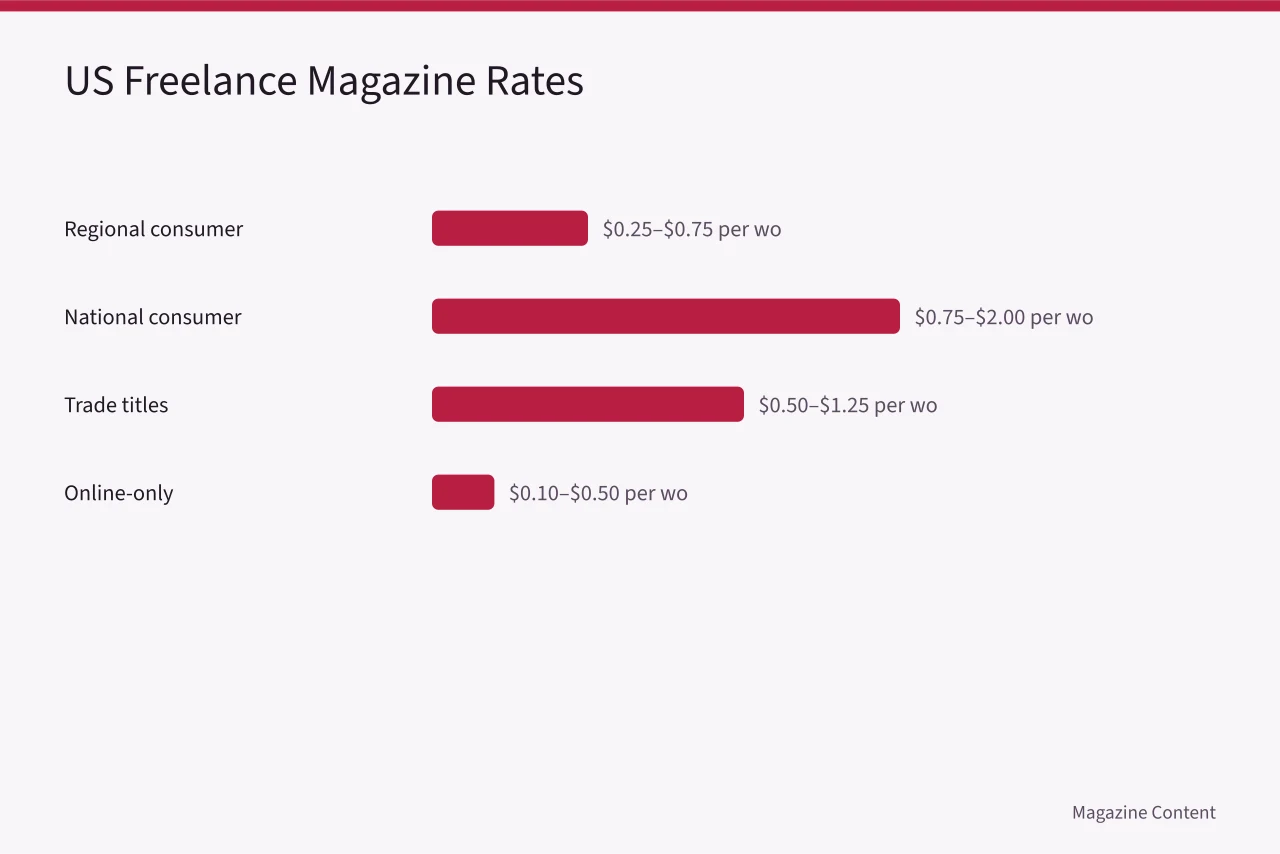
US freelance magazine writing rates vary by circulation, advertiser base, and assignment type. Illustrative ranges from editor and freelancer rate reports place regional consumer titles at $0.25 to $0.75 per word, national consumer titles at $0.75 to $2.00 per word, and trade titles at $0.50 to $1.25. Online-only magazines often pay $0.10 to $0.50 per word, though reported features can exceed that. These are benchmark ranges, not fixed union rates. Use them to test a budget, not to set a contract.
The National Writers Union has campaigned for higher floors and publishes guidance on freelance magazine writing rates; use it as a reference rather than a price list.
Most US regional magazines still pay between 30 and 60 cents per word for reported service pieces, while national titles pay more for exclusivity and investigative work.
Line by line: per word and flat fees
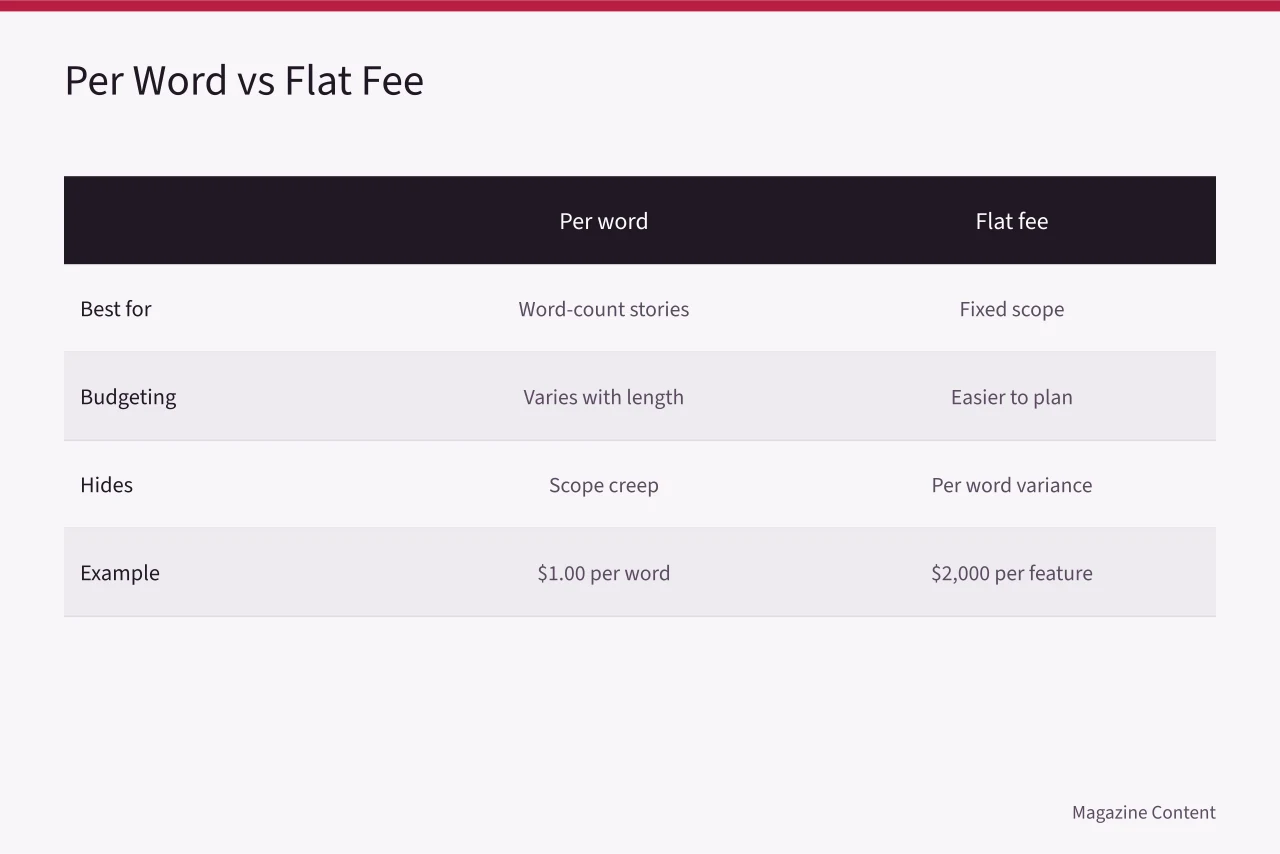
Per word works for word-count-driven stories. Flat fees work for fixed scope. The table below gives illustrative US benchmarks for common assignments.
| Assignment type | Illustrative US range (USD) |
|---|---|
| Regional feature, 1,200 words | $360 to $900 |
| National feature, 2,000 words | $1,000 to $4,000 |
| Trade case study, 800 words | $400 to $1,000 |
| Online news brief, 500 words | $50 to $250 |
| Recurring column, monthly | $300 to $1,000 per issue |
Flat fees are easier to budget but hide per word variance. A 2,000 word national feature at $2,000 is $1.00 per word. An 800 word trade piece at $800 is $1.00 per word, but the reporting burden differs. Use both per word and flat benchmarks when comparing bids. The typical pay structures for a freelance writer include per word, per piece, and hourly billing, which is why rate cards should state the basis for every assignment.
Fixed against variable
One-off article fees are variable costs tied to the issue. A recurring column is a fixed commitment for a set term, often 6 or 12 issues. The budget should show them separately, because cutting a column saves money only after the current contract ends. A one-off feature can be cut from the next issue without a contract penalty.
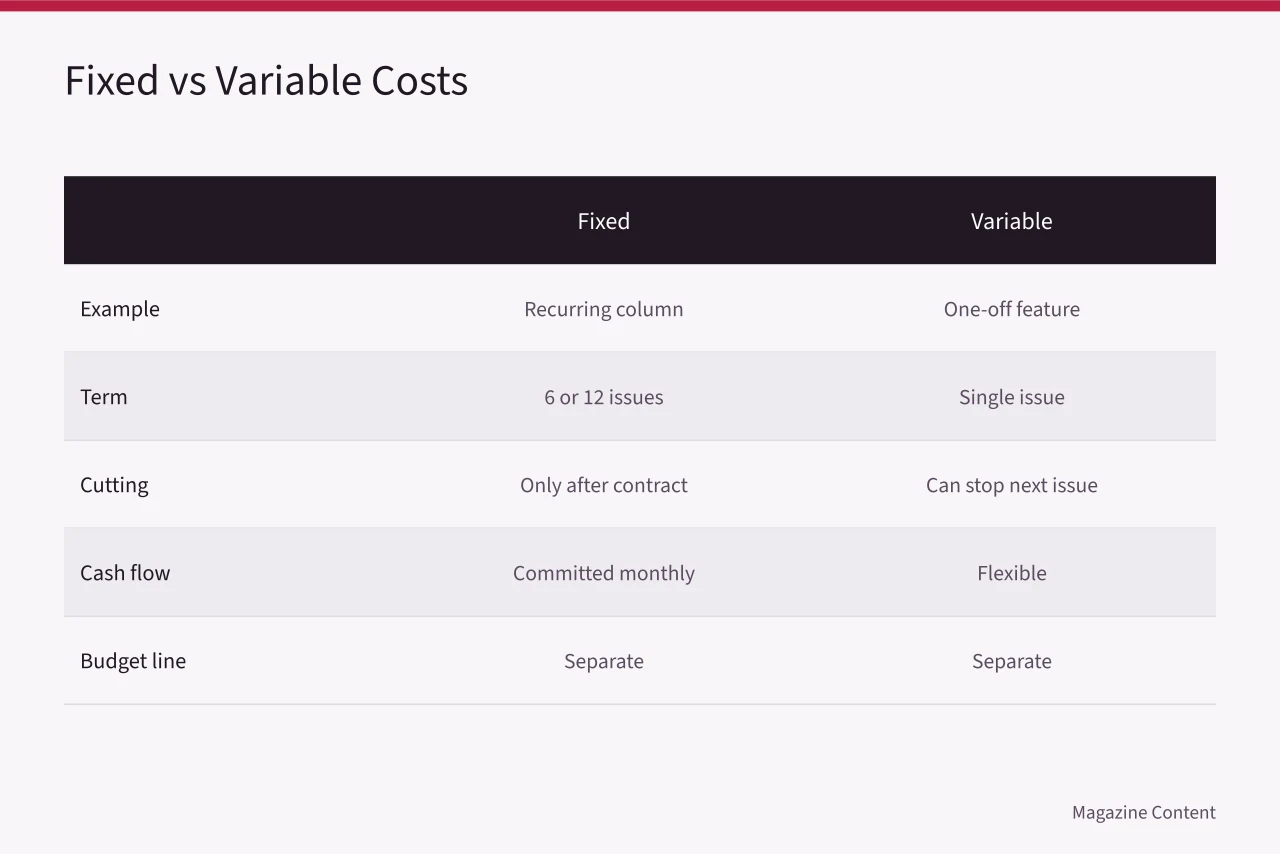
This distinction matters for cash flow. If a magazine signs three monthly columns at $500 each, that is $1,500 per month committed. A single feature budget of $1,500 can stop or shift. Make that split visible in the rate card and in the financial plan.
What published rate guides do not include
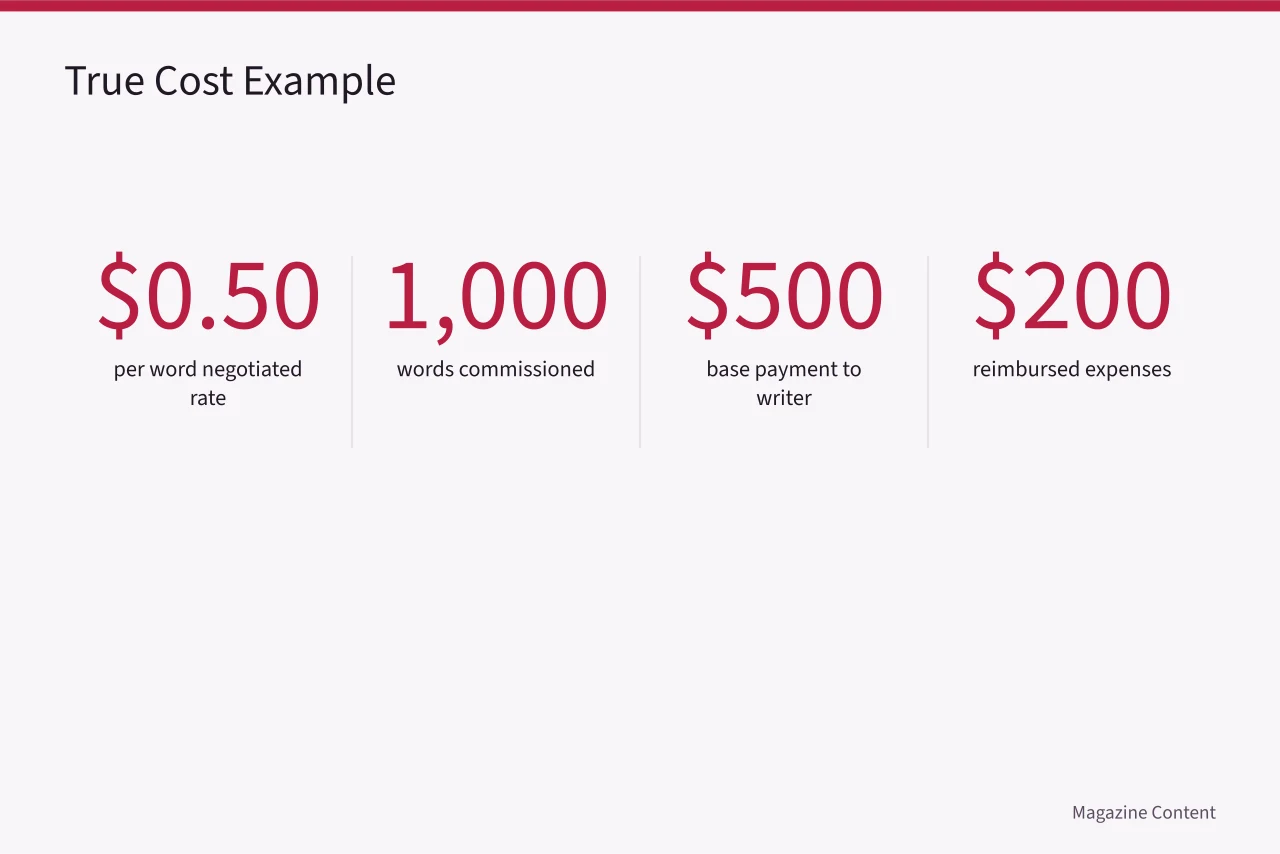
Published freelance rate guides list base rates. They rarely include expenses, revisions beyond two rounds, kill fees, or rush pay. Travel, records fees, database access, and photography permissions sit outside the per word rate. If a writer negotiates $0.50 per word for a 1,000 word piece, the magazine pays $500. The true cost may be $700 after $200 in reimbursed expenses. Budget for these separately.
Before commissioning sensitive stories, editors should pair rate decisions with legal review; see defamation law for magazine editors.
Where budgets leak
Budgets leak in four predictable places. First, revision rounds that exceed the contract scope. Second, kill fees for assigned stories that do not run. Third, late payment penalties or rush surcharges on quick turnarounds. Fourth, expenses authorized verbally but not added to the invoice system. Track each with a line item, not as part of the base rate.
- Add a kill fee clause of 25 to 50 percent.
- Cap revision rounds at two.
- Require written approval for expenses over $50.
Ad revenue assumptions behind rate cards show up in a magazine's media kit; see media kit examples to price ad inventory against editorial spend.
Common questions
What should a US magazine pay per word in 2025? Illustrative ranges are $0.25 to $0.75 for regional consumer titles, $0.75 to $2.00 for national consumer titles, and $0.50 to $1.25 for trade titles. Online rates often run $0.10 to $0.50 per word.
Do I pay more for reported features than for essays? Yes, reported features carry higher flat fees and per word rates because they require sources, verification, and time.
Should kill fees be a separate budget line? Yes, set aside 10 to 15 percent of the feature budget for kill fees on stories that are assigned but never published.
How do I handle expenses in a freelance rate card? Show reimbursed expenses as a separate line, not inside the per word rate. Require written preapproval for anything over $50. See editorial style guide for revision rules that reduce expense disputes.