Maintenance
Part of Magazine print production, paper, and prepress: a practical guide
Magazine prepress and print handoff checklist
Magazine prepress checklist for job specifications, pages, images, fonts, color, bleed, PDF export, proof approval, file delivery, and printer confirmation.
What to take away
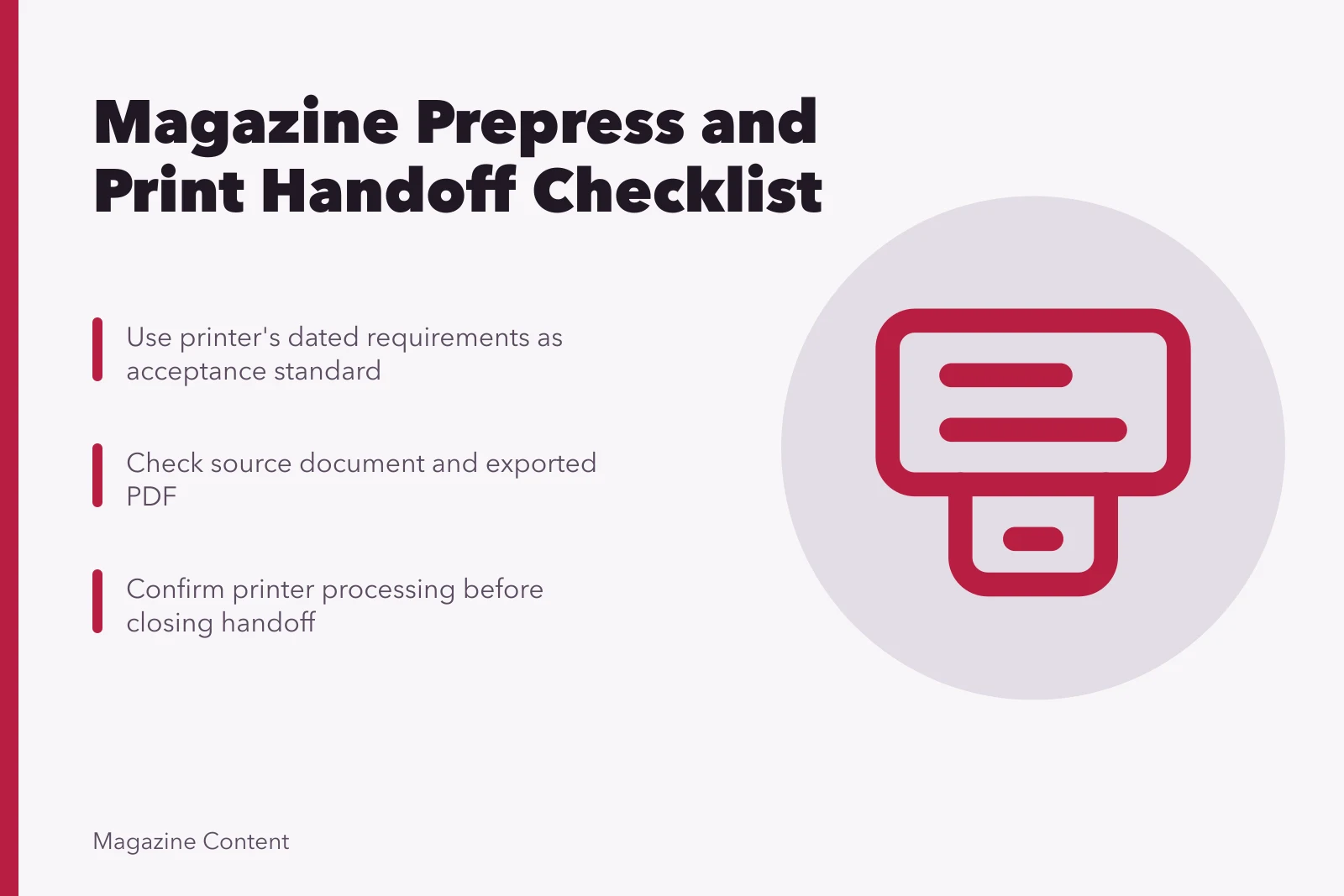
- Use the printer's dated requirements as the acceptance standard.
- Check both the source document and the exported PDF.
- Assign each approval to a named person and file version.
- Treat warnings as decisions that need evidence, not boxes to dismiss.
- Confirm successful printer processing before closing the handoff.
This checklist is for a production editor releasing a magazine to print. Adapt it to the supplier's binding, press, stock, finishing, and file rules.
Wikipedia's account of imposition describes how pages are arranged on the printer's sheet. Its parameters: finished page size, total page count, the stitching or binding method that forms the signatures, and paper grain, whose fibers must run lengthwise along the fold.
Those variables decide whether a late page change is trivial or expensive. That is why this checklist starts with the job definition, not the file.
A. Job definition
Job definition essentials
- Publication, issue, component, job number agree
- Final trim size and orientation confirmed
- Page count final and binding-valid
- Cover, spine, flaps, gatefolds defined
- Stocks identified by supplier and grade
- Process colors, spot inks, coatings listed
- Proof type, approvers, deadlines named
- Publication, issue, component, and job number agree across records.
- Final trim size and orientation are confirmed.
- Page count is final and valid for the binding method.
- Cover, spine, flaps, gatefolds, inserts, and special sections are defined.
- Cover and text stocks are identified by supplier, grade, finish, weight, and color.
- Recycled content or certification claims have supporting documents.
- Process colors, spot inks, coatings, and special finishes are listed.
- Quantity, overs allowance, packing, mailing, and delivery points are settled.
- Proof type, approvers, deadlines, and release authority are named.
B. Page plan and layout
Page plan and layout checks
- Flatplan matches PDF page order
- Section openers and ad positions correct
- Folios run correctly, blanks marked
- No overset text or hidden objects
- Trim, bleed, safe area meet guide
- Spine width from printer's calculation
- Crossovers reviewed for gutter loss
- The flatplan matches the PDF page order.
- Section openers, right-hand starts, inserts, and advertising positions are correct.
- Folios run correctly and intentional blanks are marked.
- No overset text, hidden live objects, or unresolved editorial notes remain.
- Trim, bleed, safe area, gutter, and binding loss meet the job guide.
- Spine width comes from the printer's calculation using final stock and pagination.
- Crossovers have been reviewed for gutter loss, creep, and subject placement.
- Dielines and fold marks sit on named technical layers or plates as specified.
C. Images and graphics
Images and graphics checks
- Every placed asset present and up to date
- Effective resolution suitable at placed size
- Crops, rotations, masks intentional
- Color treatment matches agreed workflow
- No accidental RGB or spot objects
- Transparency and blend effects render correctly
- Barcodes tested at final size
- Every placed asset is present and up to date.
- Effective resolution is suitable at the placed size.
- Crops, rotations, masks, and clipping paths are intentional.
- Color treatment matches the agreed workflow.
- Small details will survive the chosen paper and print process.
- No accidental RGB, indexed, grayscale, or spot objects remain where prohibited.
- Transparency and blend effects render correctly over every background.
- Barcodes and machine-readable marks have been tested at final size.
D. Type, lines, and color
Type, lines, and color checks
- Fonts licensed and embedded or outlined
- Missing-glyph and substituted-font warnings resolved
- Small black text uses single-color construction
- Rich black recipes match printer limits
- Reversed type and fine rules thick enough
- Spot-color names exact, duplicate swatches removed
- Total ink coverage within printer's limit
- Fonts are licensed for the workflow and embedded or outlined as requested.
- Missing-glyph and substituted-font warnings are resolved.
- Small black text uses the approved single-color construction.
- Rich black recipes match printer limits and are not applied to fine type.
- Reversed type and fine rules are thick enough for the process.
- Spot-color names are exact and duplicate swatches are removed.
- Overprint settings are intentional, especially for white objects.
- Total ink coverage stays within the printer's stated limit.
E. PDF export and preflight
PDF export and preflight checks
- Correct printer preset and PDF standard used
- Pages or spreads exported in requested form
- Page boxes, bleed, marks, output intent correct
- Downsampling and compression preserve quality
- Fonts embedded as required
- Automated preflight ran against correct profile
- Separations, overprint, transparency checked
- The correct printer preset and PDF standard were used.
- Pages or spreads were exported in the requested form.
- Page boxes, bleed, marks, and output intent are correct.
- Downsampling and compression preserve required image quality.
- Fonts are embedded as required.
- Automated preflight ran against the correct job profile.
- Each warning has been fixed or accepted by a named responsible person.
- The PDF was visually inspected page by page after export.
- Separations, overprint preview, transparency, and ink coverage were checked.
F. Proof and correction control
- Every proof identifies file version, date, condition, and intended decision.
- Editorial proof approval covers copy, captions, credits, and page order.
- Color approval uses the agreed proof and viewing condition.
- A folded dummy or binding sample resolves physical questions where needed.
- Corrections are numbered, assigned, completed, and verified.
- A new PDF and preflight report follow every production change.
- Final approval names the exact released filename.
G. Printer handoff
The GPO's Citizen Airman magazine specification shows why handoff details must be explicit. It specifies a self-covered saddle-stitched product, four-color printing, supplied PDF pages, embedded fonts, trim, proofing, binding, and distribution terms. Use such detail as a model for clarity, not as the specification for an unrelated job.
- The release folder contains only approved deliverables.
- Filenames follow one version convention.
- A manifest lists each file, page range, size, and checksum if used.
- Transfer completed without error.
- The printer confirmed receipt of the same filenames and sizes.
- The printer's preflight or RIP report was reviewed.
- Any printer-side change or substitution received written approval.
- Emergency contacts and decision limits are known.
H. Archive after release
- Final source package and released PDF are retained.
- Job sheet, quote, purchase order, proofs, corrections, and approvals are filed.
- Paper, ink, binding, and finishing substitutions are recorded.
- Delivery and quality findings are added to the issue closeout.
Common questions
Can a preflight pass replace visual review?
No. It verifies configured properties. It cannot judge meaning, page rhythm, wrong captions, weak crops, or every rendering surprise.
Should all warnings block release?
Warnings need review. Some describe intentional construction, but the acceptance must be tied to the correct profile and recorded.
Is the printer responsible for correcting supplied files?
Only under an agreed scope. Require notification and approval before any printer-side edit that can change appearance or content.
When is the handoff finished?
After the printer confirms receipt and successful processing of the exact released files, with any exceptions resolved.