Guides
Correcting a Magazine Feature: Verifying Material and Technical Claims
Magazine corrections: how to verify a technical claim, fix the body, caption and syndication, and publish a dated notice that holds up under scrutiny.
What to take away
- A material or process claim is a factual claim, and it needs documents.
- When credible contrary evidence arrives, pause the claim, not the story.
- Correct every surface of the story, not only the article body.
- Write a dated notice that names the error and the corrected fact.
- Add a material-confidence field to every assignment.
Where material claims enter a magazine feature
A feature that calls a sculpture weathered iron has made a factual claim about composition. So has a line about a supplier's alloy, a paper stock or a printing method.
Captions carry the shorthand and fail first, which is why a pass using this guide to write and verify magazine photo captions belongs in the same workflow.
Readers treat those nouns as verified reporting. Advertising regulation already works this way, with the FTC guidance on advertising claims requiring evidence before a claim reaches the public.
The verification sequence before you rewrite
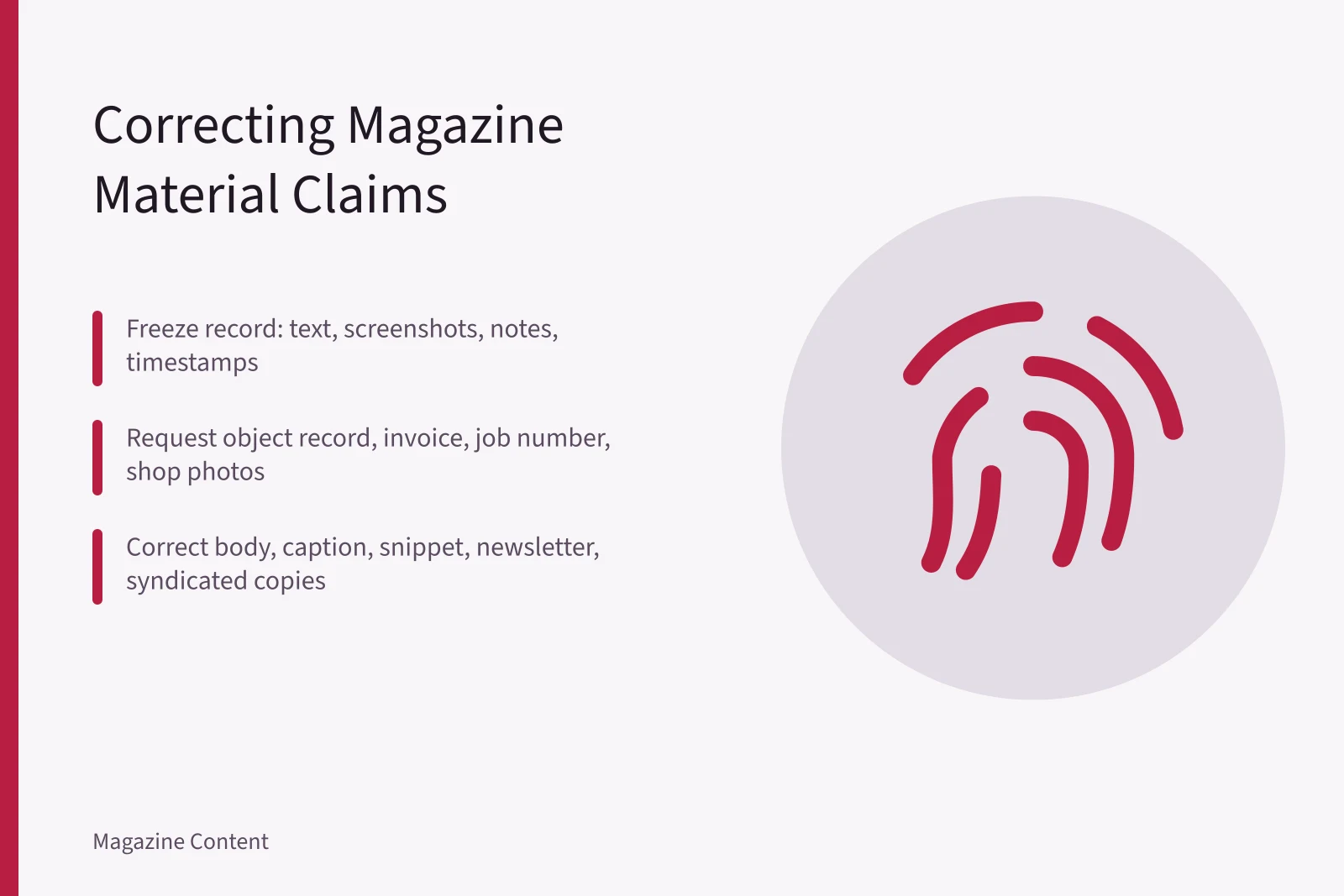
Freeze the record first. Keep the published text, screenshots, submission notes, correspondence and timestamps.
The verification sequence
- Ask the studio, gallery or manufacturer for the object record and fabrication documents.
- Request the invoice, job number and shop photographs that tie those documents to the piece.
- Obtain qualified analysis, and ask what the method did not test.
- Note what the evidence cannot reach, including a concealed core or a replaced fitting.
- Have a second editor check the revised copy against the documents.
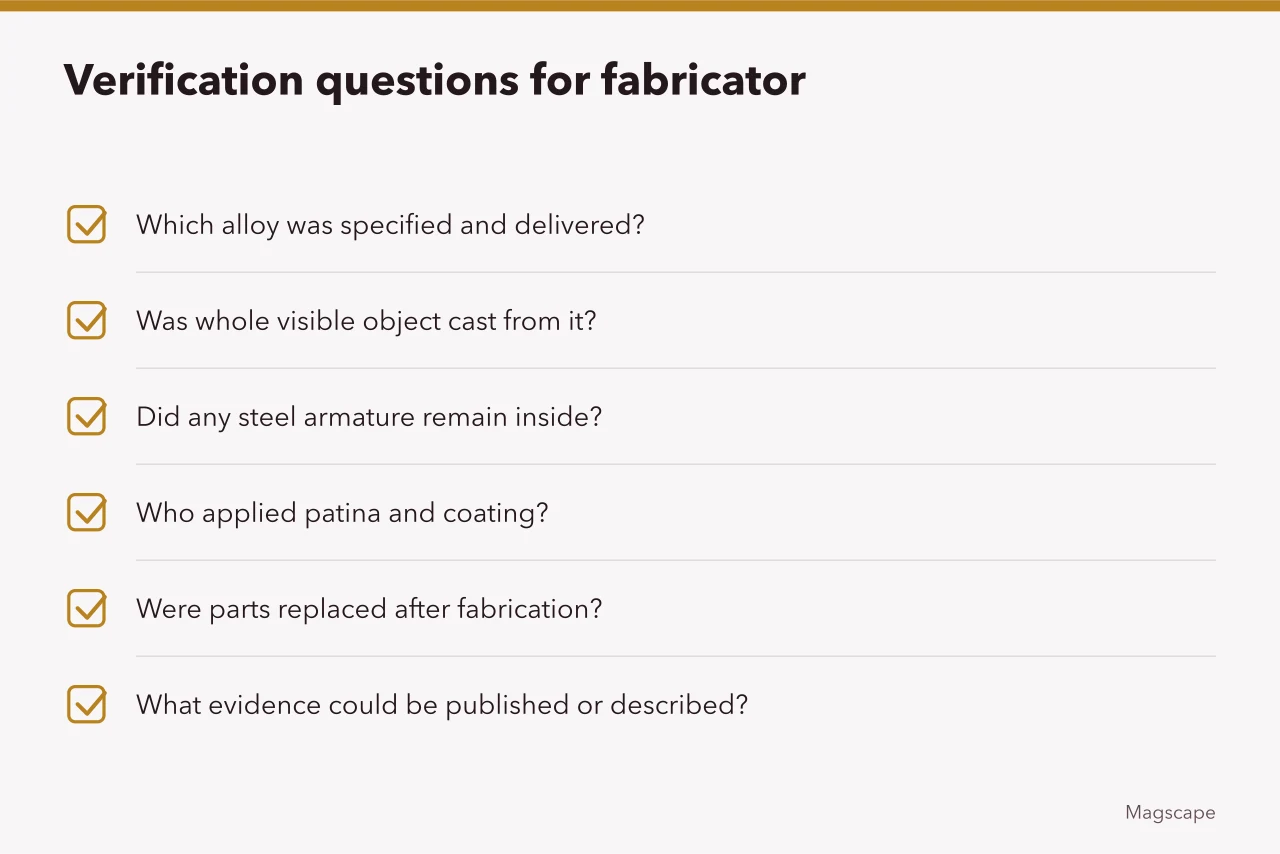
Keep the questions narrow, and put them in writing so the answers survive staff changes. Ask what the material is, how the finish was applied, what is concealed, whether parts were replaced and what documents the source will release.
Records and permissions often arrive in the same envelope, so keep this magazine photo clearance and caption checklist beside the assignment.
What the evidence supports, and what it does not
One test report rarely covers a whole object. A portable X-ray fluorescence reading applies to the points it touches. It says nothing about a concealed core or a replaced fitting.
Fabrication records plus a qualified reading can support a phrase such as cast bronze with an applied patina. They cannot support a claim about where the metal was sourced.
Updating every surface of the story
A correction that stops at the article body leaves the error in the caption, the search snippet, the newsletter and the licensed copy.
Treat those as one job, with one deadline and one editor holding the list.
The same corrections must reach licensed and syndicated copies, and the fixes in this piece on photo editing, caption and rights problems apply to every file that has already shipped.
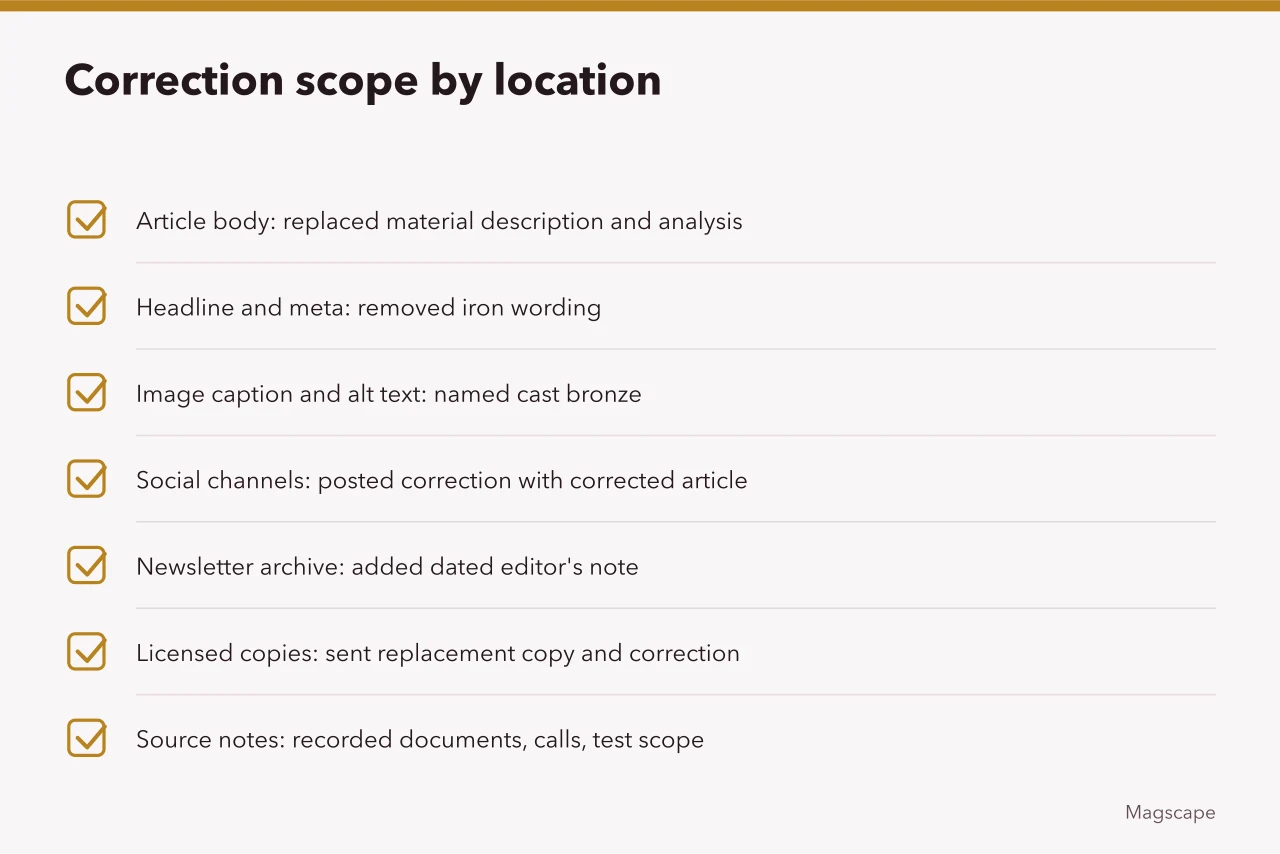
Updating every surface
| Location | Action |
|---|---|
| Article body | Replace the material description and the analysis built on it |
| Headline and meta description | Remove the metal name |
| Caption and alt text | Name the documented material and finish |
| Newsletter archive | Add a dated editor's note |
| Licensed and syndicated copies | Send replacement copy and correction wording |
| Stock and back issues | Reprint, sticker or slip the corrected page |
A printed slip in unsold copies beats a reprint and keeps the corrected title saleable beside your other back issues.
Example: a correction notice that holds up
A correction is not an update. An update adds a fact; a correction says the magazine got something wrong.
Correction, June 18, 2027: An earlier version identified the sculpture as weathered iron and read its surface as rust. Fabrication records and qualified review of material analysis show the visible work is cast bronze with an applied patina. We corrected the description, the caption and the analysis.
A notice that names the error and withdraws the wrong claim is the strongest form, and this guide to defamation law for magazine editors explains why silent edits leave exposure open.
The studio, object and documents in this example are invented.
Prevention at the assignment desk
Add a material-confidence field to every assignment. Each claim gets one of four labels: documented, specialist-confirmed, visually described or unknown.
- Technical nouns in a headline or caption need the same support as the body.
- Substrate, coating, finish and internal structure are separate fields.
- A visually described claim goes to a second reader before layout.
Write the accepted vocabulary into the house style guide, so the next writer knows which terms need a document behind them.
Set the threshold in the commissioning note, and name it in the brief. A writer who knows that alloy, paper and process claims need a source will supply one with the first draft, which saves the desk a correction later.
If unsold copies get a slip or a reprint, run the revised pages through this magazine design review checklist before the press date.
Common questions
Was a correction needed if the sculpture looked like iron?
Yes. The article stated composition as fact and built its reading of the work on that statement.
Should the whole feature have been pulled?
No. The observations that did not depend on the material could stand once the false premise was corrected.
Does one test settle every question about an object?
No. Results apply to the tested points and rarely cover hidden structure or replacement parts.