Guides
How to Price Canadian Magazine Advertising Rates
Canadian magazine advertising rates run about $450 to $6,500 per page in CAD, set by circulation, audience and format. Here is how to build a rate card.
What to take away
- Full-page rates at independent Canadian magazines commonly sit between roughly $450 and $6,500 in CAD, with national titles above that band. Treat every figure here as illustrative rather than surveyed.
- The rate card is a menu of formats, not one number: full page, half page, spread, cover positions and advertorial each carry their own price.
- Buyers compare on CPM, so a small circulation with a tight audience can still charge a premium per thousand.
- Fixed costs (design, administration) and variable costs (print, postage, commissions) behave differently when you add pages.
- Discounts, agency commission and unsold inventory are where ad revenue quietly disappears.
What the range covers
A rate card states what an advertiser gets and what it costs. Production of the ad itself is almost never included. Neither is the extra print run, the mailing or the sales commission.
Canadian circulation matters more than national averages. A city magazine with 8,000 controlled copies and a provincial association title with 3,000 paying members are different products, and their prices should reflect that. The Canada Periodical Fund recognises that distinction in its own eligibility rules, and so should your card.
Line by line
The table below shows a mid-size independent title, roughly 10,000 copies, six issues a year. Figures are illustrative in CAD.
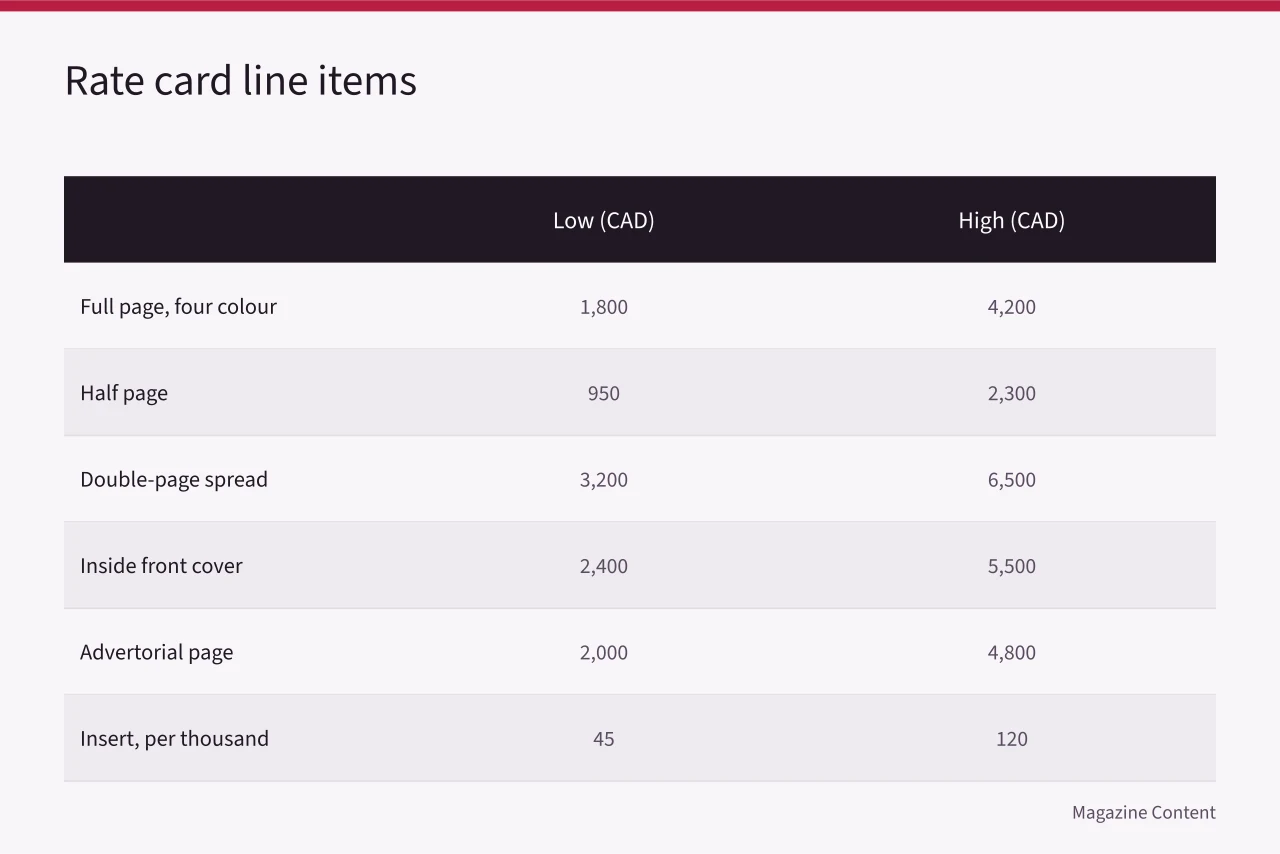
| Item | One-off or recurring | Low (CAD) | High (CAD) |
|---|---|---|---|
| Full page, four colour | Recurring | 1,800 | 4,200 |
| Half page | Recurring | 950 | 2,300 |
| Double-page spread | Recurring | 3,200 | 6,500 |
| Inside front cover | Recurring | 2,400 | 5,500 |
| Advertorial page | Recurring | 2,000 | 4,800 |
| Insert, per thousand | Recurring | 45 | 120 |
| Artwork setup and prepress | One-off | 150 | 400 |
| Media kit design refresh | One-off | 600 | 2,500 |
Smaller community titles often sit below the low column. National consumer magazines with audited circulation sit well above the high column.
Fixed against variable
Fixed costs do not move when you sell one more page. The rate card itself, the media kit, the sales inbox, the invoicing routine and the basic page grid all exist whether or not the ad sells.
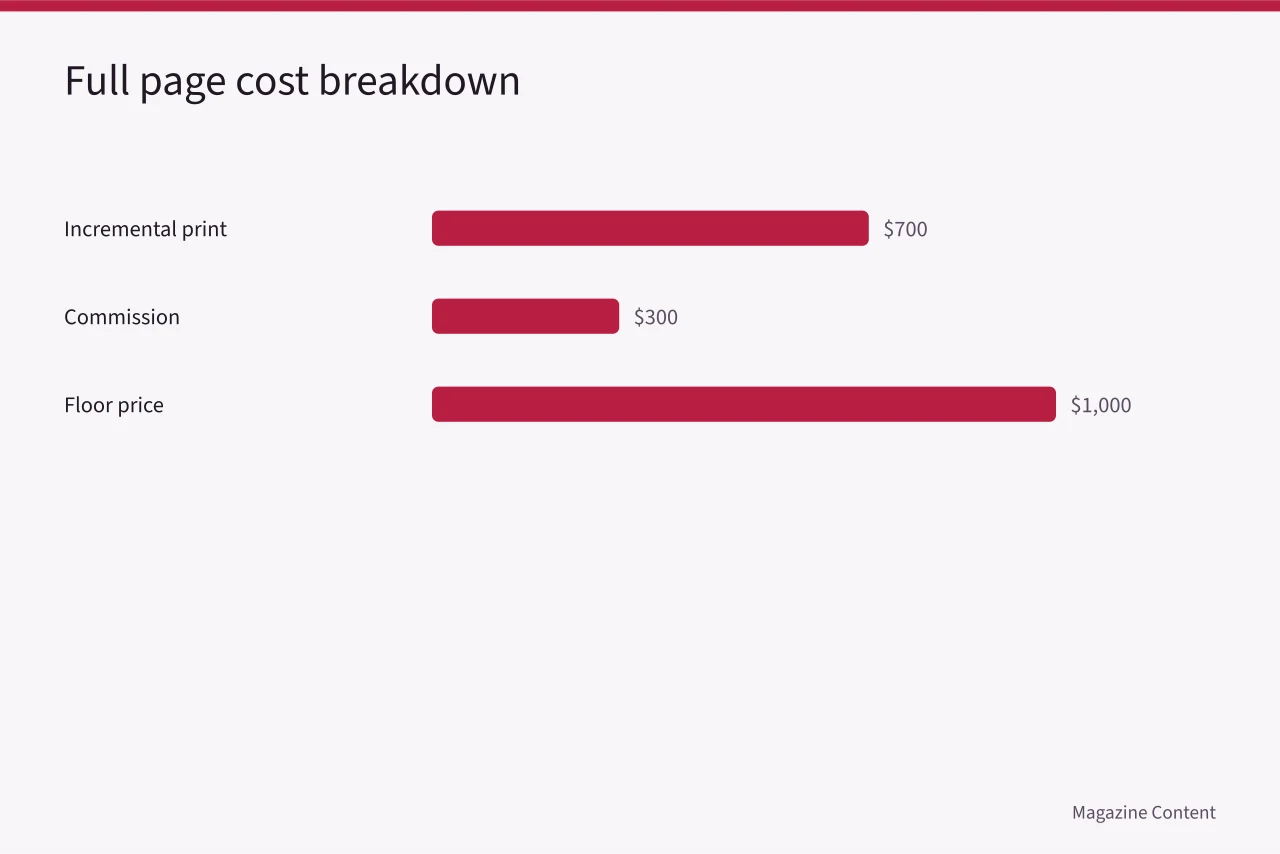
Variable costs rise with each sale. Print, paper, binding and postage grow with every added page. Agency commission, usually 15 per cent, comes off the top. A sales rep on commission takes another slice.
That split decides your floor price. If a full page costs $700 in incremental print and $300 in commission, anything under $1,000 loses money before overhead.
What the tools do not include
Software will produce a rate card, a CPM calculation and an insertion order. It will not tell you what a buyer will pay.
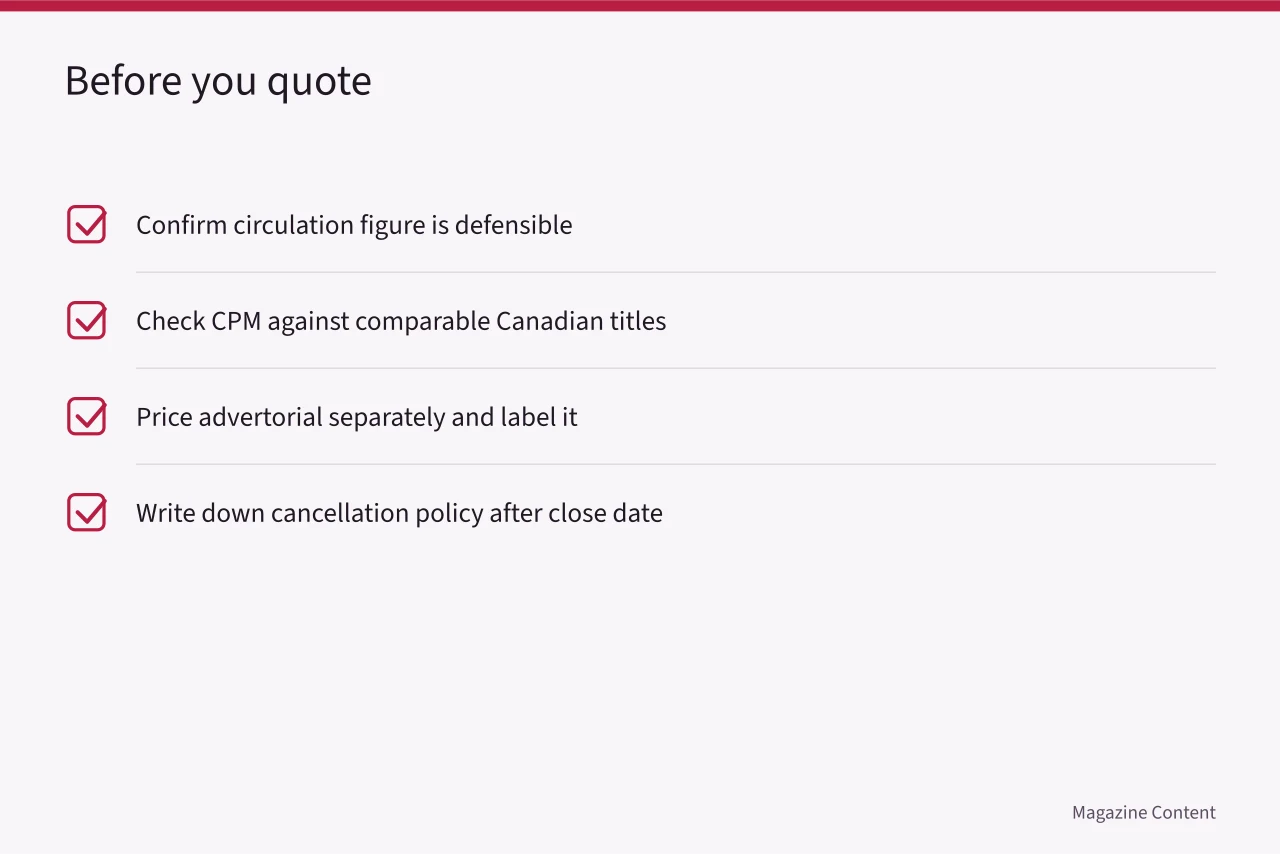
- Confirm your circulation figure is defensible before quoting it.
- Check whether your CPM sits near comparable Canadian titles.
- Price advertorial separately and label it clearly.
- Write down what happens when a client cancels after the close date.
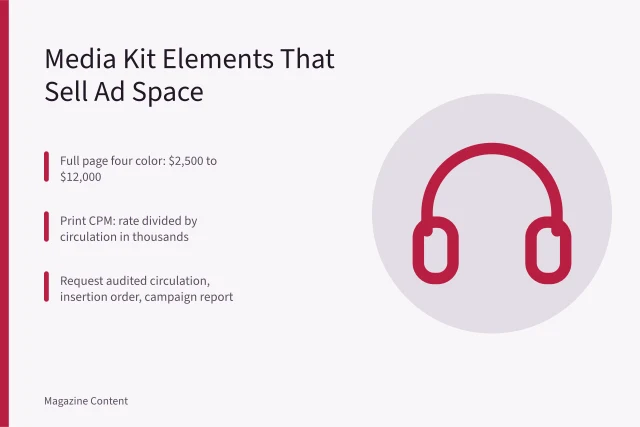
The media kit is the document buyers actually read, and its structure shapes how they judge your prices; Magazine Media Kit Examples: What to Include to Sell Ad Space breaks down what belongs on each page. CPM itself is simple arithmetic, and the standard definition is worth keeping in front of you when a buyer asks you to justify a number.
Where budgets leak
Discounts leak first. A standing discount for a six-issue commitment is normal. A discount granted in the last week of a slow quarter is a habit, and buyers learn it.
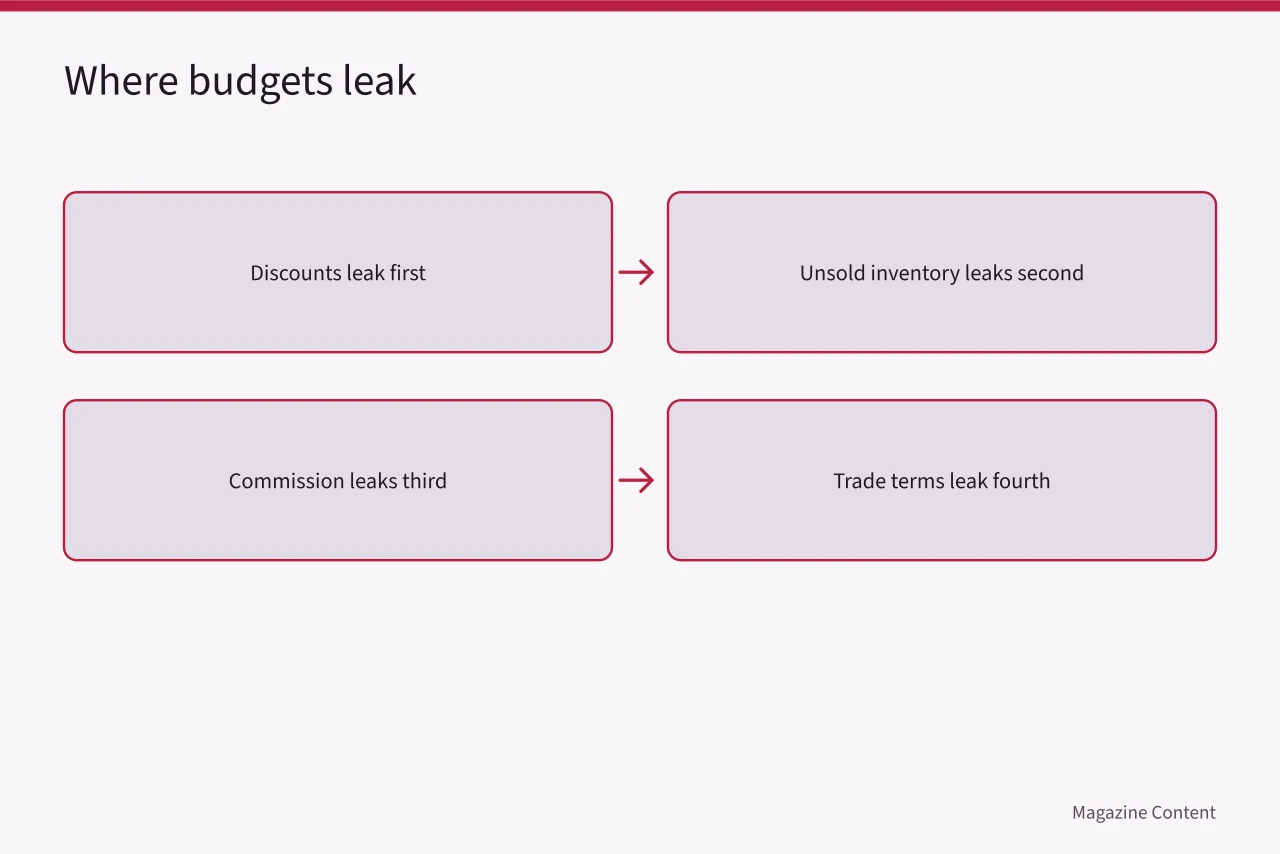
Unsold inventory leaks second. A page that goes empty earns nothing and still costs the same to bind into the issue. Remnant pricing fills it, but it trains regular clients to wait.
Commission leaks third. If you quote a gross rate and pay 15 per cent to an agency, your net is 85 per cent of the card. Many publishers quote net rates to agencies and gross to direct clients. Decide which you are doing before the first call.
A rate card is a promise about value. Break it for one advertiser and every other advertiser eventually hears about it.
Trade terms leak fourth. Barter deals for services can be useful, but they should be valued at your card rate in writing, not at whatever the other party says its service is worth.
Example
A prairie city magazine prints 9,000 copies, six times a year. It sets a full page at $2,600 and a half page at $1,400. Print and paper add about $620 per page, commission about $390, leaving roughly $1,590 per full page before salaries.
Sell 14 full-page equivalents an issue and the title clears about $22,000 gross per issue, or $133,000 across the year. Sell six and it does not cover production. The card price is only half the calculation; the other half is how many pages actually sell.
If your sell-through is the weak point rather than the price, the arithmetic in Magazine Subscription Pricing: What Should Independent Publishers Charge? shows how reader revenue can carry the fixed side of the budget.
Common questions
What CPM should a Canadian magazine charge? Independent titles commonly land between $80 and $250 per thousand, with specialised audiences at the top of that band. National titles with audited circulation often sit lower because the audience is broader.
How often should rates change? Once a year is typical, announced before the first issue of the new volume. Mid-year increases damage trust unless print or postage costs have moved sharply.
Do I have to publish the card? No. Many publishers keep the full card internal and quote per client. If you publish it, keep the numbers consistent with what you actually charge.
Can I charge more for a cover position? Yes, and most titles do. Inside front and inside back usually carry a 20 to 40 per cent premium over a run-of-book page.