Guides
Magazine Subscription Pricing: What Should Independent Publishers Charge?
Magazine subscription pricing for independent US publishers: what a print or digital title should charge, with USD cost ranges and price points.
What to take away
- Most independent US magazines should test an annual print price between $25 and $60, with digital-only titles between $3 and $6 a month.
- Dollar figures below are illustrative ranges, not industry averages.
- One-off launch costs differ from recurring production costs, and both must feed the price.
- A recurring cost per subscriber above the price cannot be fixed by volume.
- Check competitor price points and renewal behavior before setting a rate.
Pricing a subscription starts with unit economics, not with a guess.
What the range covers
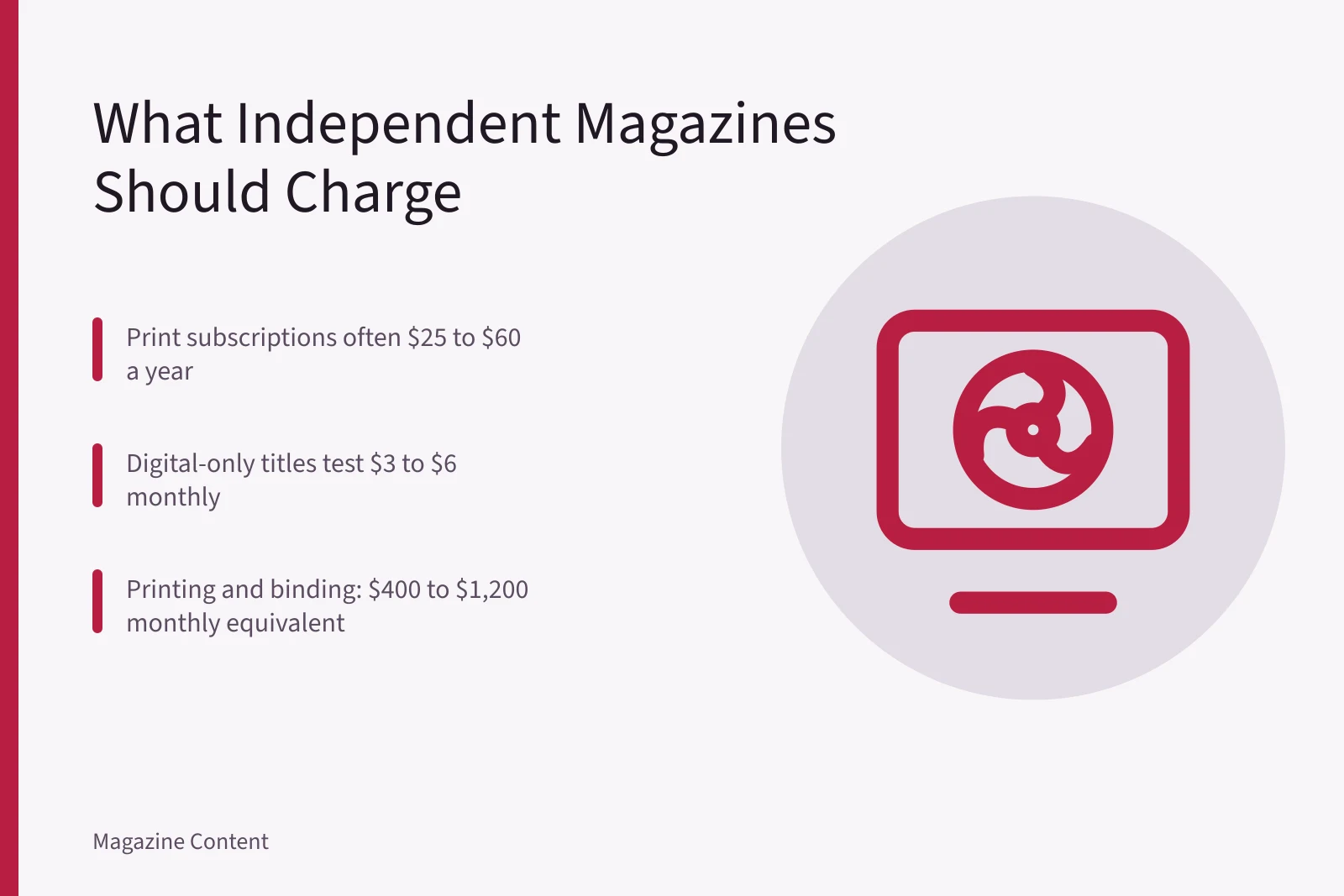
Independent US publishers operate in a different band from mass-market titles. Newsstand weeklies sell for $4 to $8 per copy, but print subscriptions often land from $25 to $60 a year. Digital-only magazines commonly test $3 to $6 a month. Use the Small Business Administration's market research guide to log competitor rates before you choose a figure.
The range covers postage, printing, payment processing, editorial labor and a small margin. It does not include acquisition cost if you rely on paid social ads or direct mail.
Line by line
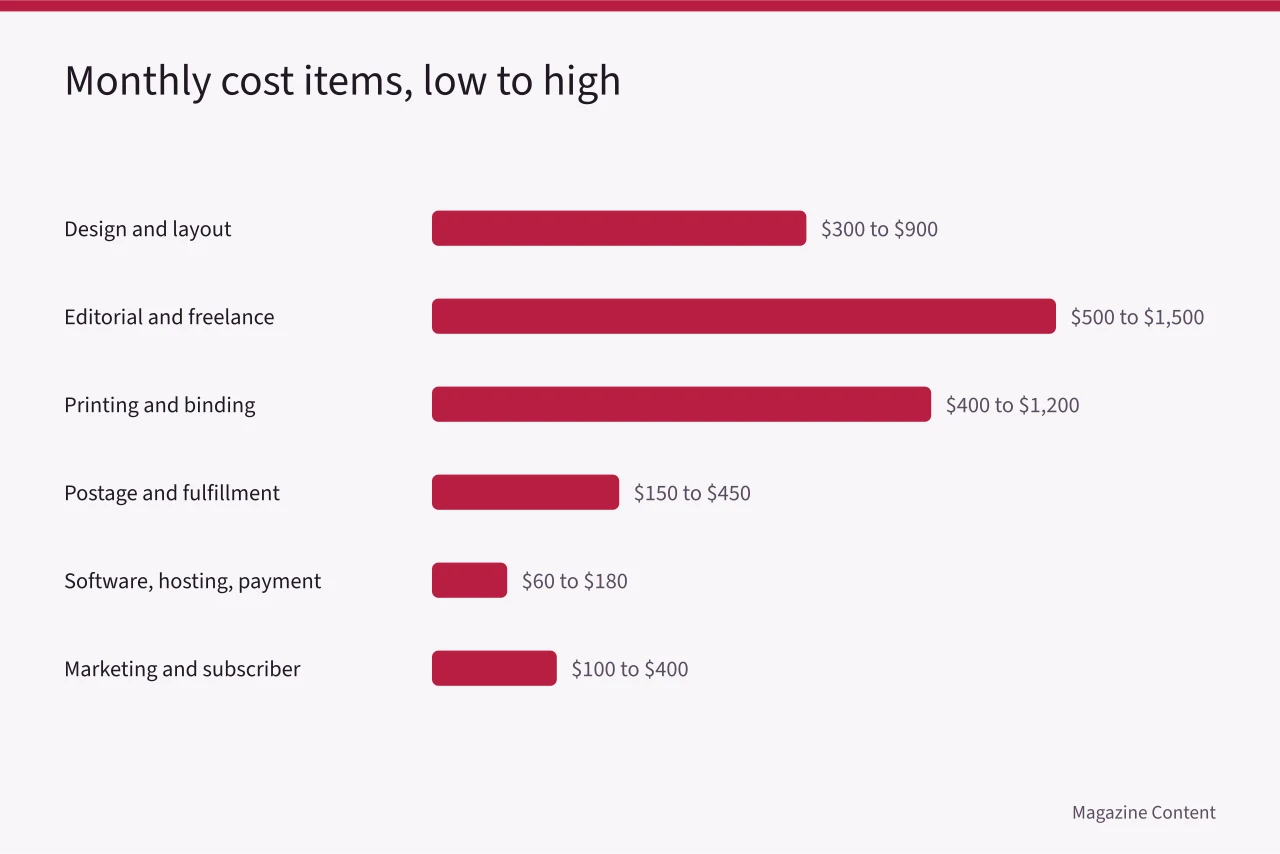
The table below is an illustrative monthly equivalent for a small title producing one print issue and a digital edition. Printing and binding costs are shown as a monthly equivalent across a four-issue year.
Show the numbers
| Design and layout | $300–$900 |
|---|---|
| Editorial and freelance | $500–$1,500 |
| Printing and binding | $400–$1,200 |
| Postage and fulfillment | $150–$450 |
| Software, hosting, payment fees | $60–$180 |
| Marketing and subscriber service | $100–$400 |
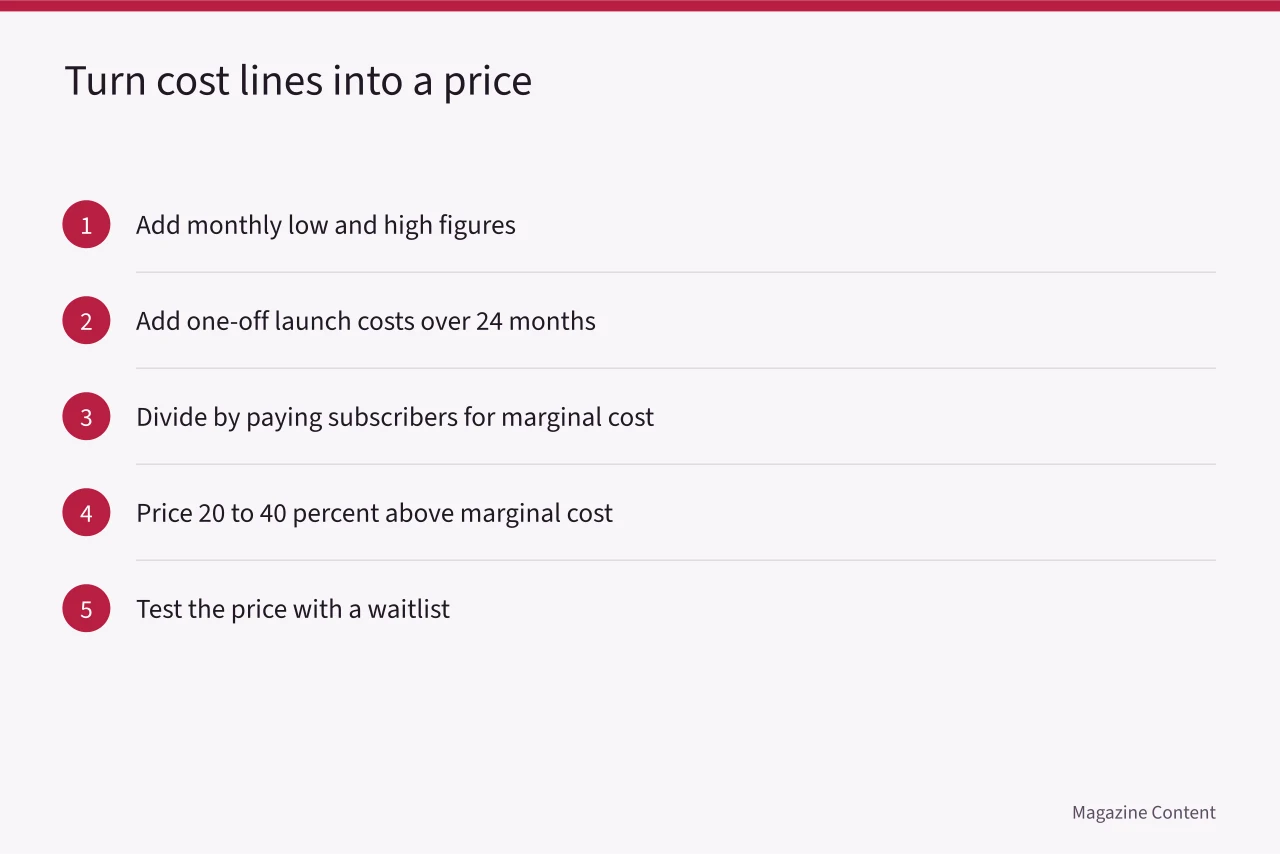
To turn these lines into a price:
- Add all monthly recurring low and high figures to get a monthly cost band.
- Add one-off launch costs spread over 24 months.
- Divide by paying subscribers to get a marginal cost per subscriber.
- Price 20 to 40 percent above that marginal cost and test with a waitlist.
A subscription price that cannot cover postage, payment processing and printing is a donation, not a business.
Before you trust these figures, see Magazine design, layout, and typography for how paper and format drive the high end.
Fixed against variable
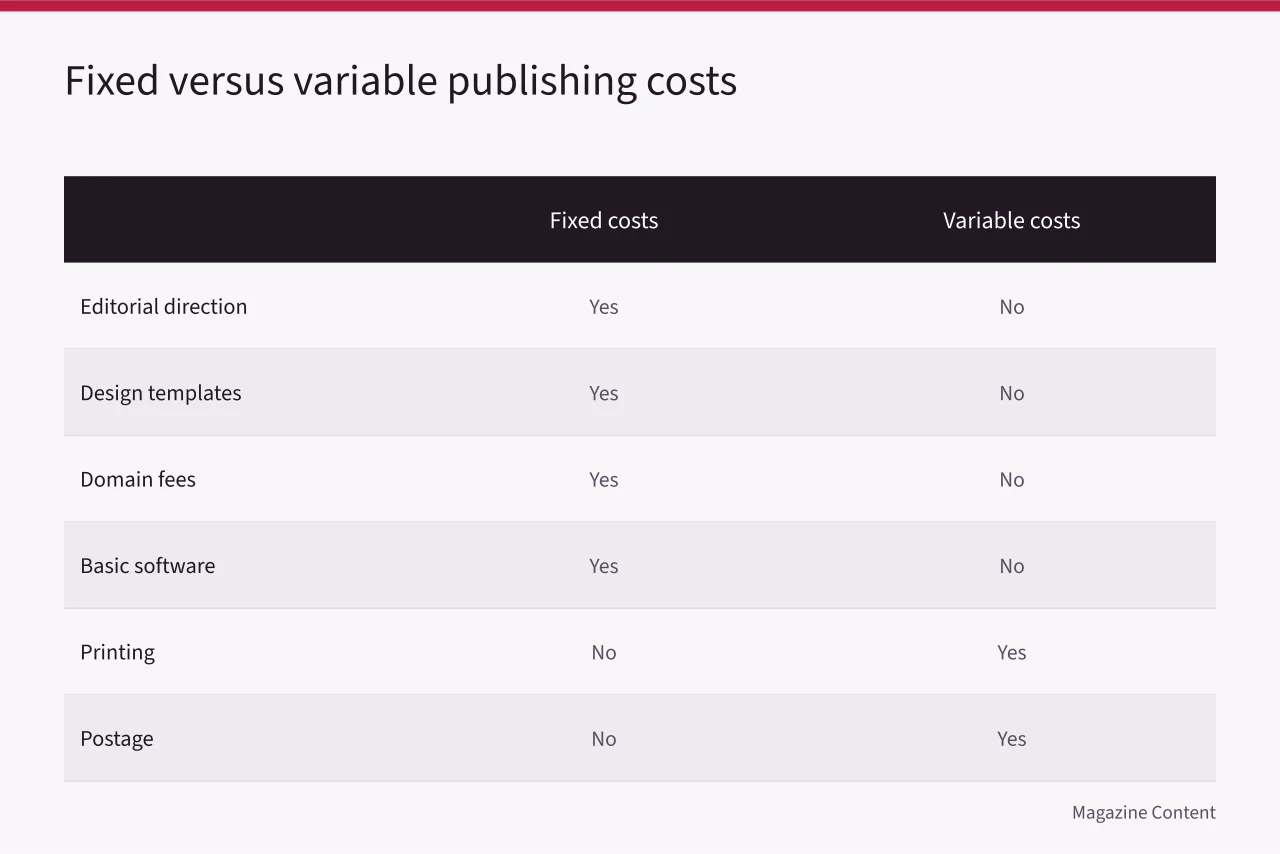
Fixed costs recur whether you sell one subscription or five hundred. Editorial direction, design templates, domain fees and basic software fall here. Variable costs rise with each subscriber or issue: printing, postage, payment processing and support time.
One-off costs include logo design, initial layout system, media kit photography and setup for a subscription app. Spread these across at least two years so a single launch month does not distort the price.
Layout time includes template fixes, color proofs and preflight checks. A reusable flexible magazine layout system keeps design cost stable as the issue count rises.
What the tools do not include
No tool will set the right price for your audience. Publishing platforms, payment processors and analytics dashboards track revenue after the fact. They do not tell you that a reader will accept $42 but leave at $48.
Digital payment tools also exclude postage. A web checkout that charges $5 a month may look profitable until the print fulfillment cost lands in a separate spreadsheet. Analytics also fail to separate renewals from gift subscriptions. A dashboard may show 400 active subs when only 250 pay full rate.
Where budgets leak
Postage increases and non-machinable surcharges leak first. A magazine that fits the USPS Periodicals class may still pay extra for polybagging or stiffeners. Recheck the real weight and dimensions after every redesign. Page weight changes with paper and grid choices, so review Magazine grid systems compared before a redesign.
Renewal notices, auto-renewal disputes and refunds are recurring costs that many publishers forget. Clear disclosure of renewal terms follows FTC advertising guidance and reduces chargebacks.
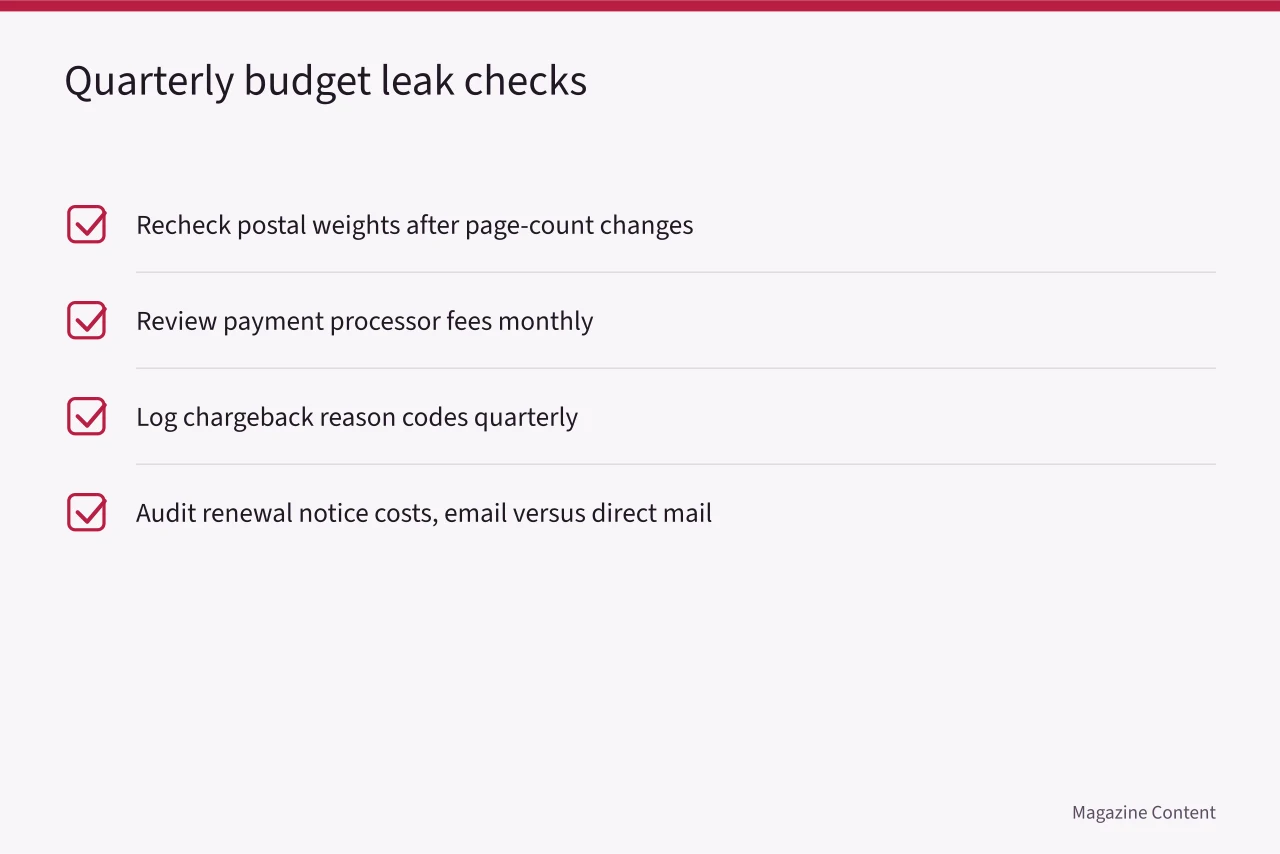
Check these leak points quarterly:
- Recheck postal weights after every page-count change.
- Review payment processor fees monthly, not annually.
- Log chargeback reason codes quarterly.
- Audit renewal notice costs against email versus direct mail.
Example: a small US quarterly print magazine
For a 48-page saddle-stitched quarterly with 400 paying subscribers, total recurring cost per issue might run $1,800 to $3,400. At four issues per year, that is $7,200 to $13,600 annually. Annual subscription revenue at $30 per subscriber is $12,000. At $45, revenue is $18,000. The higher price leaves room for refunds, bad addresses and acquisition cost. For comparable editorial cost structures, see Freelance magazine rates in Manchester, Bristol and Glasgow.
Common questions
How do I choose between $30 and $60 a year? Test both against a waitlist. Show annual page count, delivery frequency and whether the subscription includes archive access. Price near the middle if you cannot run a live test.
Should digital-only magazines price lower than print? Yes, but not always. Digital-only removes postage and printing, yet still carries editorial, software and payment costs. A $4 to $6 monthly range is common for small titles.
When should I raise an existing subscription price? Raise after you have delivered at least two issues at the current rate and can show a page-count or delivery improvement. Use a small increase, such as $5 a year, rather than a jump to newsstand level.
What is the biggest pricing mistake for independent publishers? Underpricing to attract subscribers and then relying on volume. If variable cost per subscriber exceeds the annual price, each new sale deepens the loss.