Guides
Part of Magazine photo editing: a practical guide from selection to proof
How to write and verify magazine photo captions
Photo caption method for identifying subjects, describing action, adding verified context, handling dates and locations, recording credits, rights, and alt text.
What to take away
- A caption should identify the right people and explain the relevant action.
- Visible description and outside context require different evidence.
- Date, place, direction, and sequence must be verified, not guessed from appearance.
- Credit and rights information should travel with the asset.
- Alternative text should reflect the image's purpose in its specific digital context.
A useful caption helps a reader understand why an image is present without narrating every visible object. It should be accurate on its own and consistent with the article, headline, crop, and surrounding sequence. Caption writing begins during reporting because names, positions, actions, and context are much harder to recover after the event.
Contact sheet and credit
The image illustrates frame review. Its pictured people and place are not identified here.
Gather caption facts at assignment
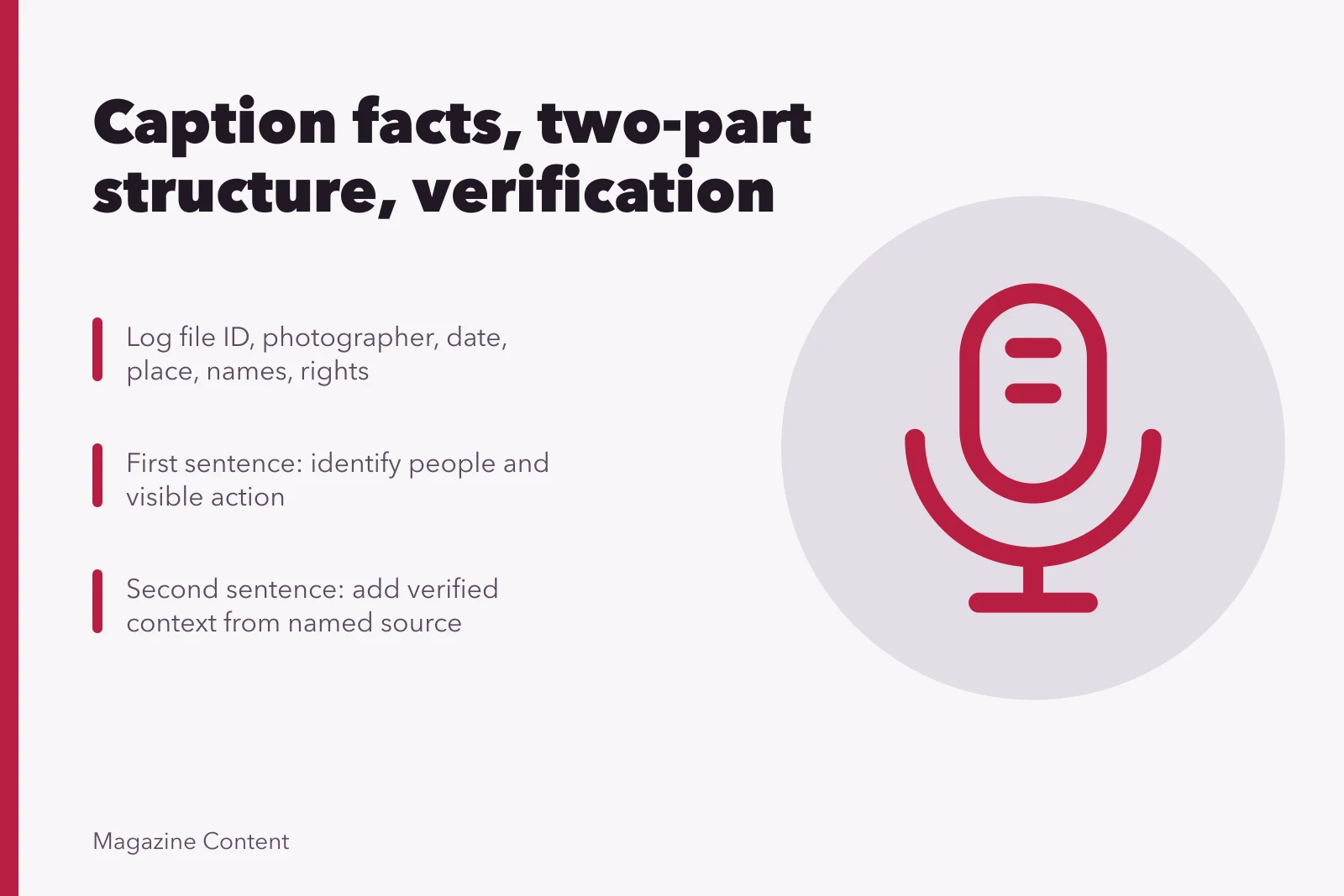
Create an image log with file ID, photographer, date, time, place, assignment, frame sequence, subject names, name spellings, pronouns when relevant, visible action, source of context, staging status, alteration notes, and rights fields. For group photographs, record positions from left to right only after confirming the final crop has not changed that order.
Image log fields to record
- File ID and frame sequence
- Photographer, date, time, place
- Assignment and subject names
- Name spellings and pronouns
- Visible action and context source
- Staging and alteration notes
- Rights fields
Do not infer identity, emotion, relationship, diagnosis, motive, or legal status from appearance. Ask the photographer what was observed and what came from another person. Mark information that remains provisional.
Use a two-part caption structure
The first sentence usually identifies the people and describes the visible, relevant action in the frame. The next sentence can add verified context: why the moment matters, what happened before or after, or how it connects to the article. Keep tense and style consistent with publication rules.
Caption, photographer, rights fields
Caption
- What it holds
- Who, what, when, where, why
- Purpose
- Describe image for retrieval
- Risk if merged
- Mistaken for rights record
Photographer
- What it holds
- Full name and organization
- Purpose
- Attribute the maker
- Risk if merged
- Lost attribution
Rights
- What it holds
- Owner and start/end dates
- Purpose
- Record permitted use
- Risk if merged
- Unclear licensing
The National Archives' requirements for digital photographic records keep those jobs in separate fields. A caption is narrative text describing the individual image so it can be understood and retrieved, and standard caption information covers the who, what, when, where, and why.
The photographer is recorded separately by full name and organization. Copyright restrictions are recorded separately again, with the owner named and any start and end dates given. Keeping those three fields distinct stops a descriptive caption from being mistaken for a complete rights record.
Verify the draft caption
Check the actual image at useful size and compare neighboring frames. Confirm:
- Every named person is visible after the final crop
- Positions, directions, and sequence are correct
- Date and place match the asset and reporting record
- Action is described rather than interpreted
- Context comes from a named source or document
- Credit matches the contract or license
- Alterations and illustration status are disclosed where required
If a subject disputes the caption, inspect the evidence rather than treating either the original or the objection as decisive. Correct the wording when the evidence changes.
Separate caption, credit, and alt text
A credit names the creator or provider under agreed terms; a rights notice or license statement records permitted use. A caption explains the editorial image; alternative text conveys its relevant information or function to someone who cannot see it in that context.
One field may inform another, but copying the same sentence into all four often produces poor results.
W3C's tutorial page on informative images says the text alternative should convey the meaning or content shown visually. It is usually not a literal description of the picture.
The page also notes an image stops being informative when nearby text already carries the same information. Then the honest alternative is an empty one, not a repeated sentence.
Handle archival and supplied images
State when a photograph is undated, approximate, staged, handout material, a file image, or a reconstruction. Preserve the institution's exact item identifier and rights advisory. For a supplied promotional image, name the source and do not imply independent observation.
Common questions
Should captions use present tense?
Follow house style. Accuracy and clear chronology matter more than a universal tense rule.
Can a caption say someone looks worried?
Only with an evidence basis and editorial reason. Observable action is usually safer than inferred emotion.
What if a person's name is unknown?
Describe only what is known and continue reporting. Do not invent a generic identity.
Should every photo have alt text online?
Every image needs an appropriate alt decision. Informative images need useful text; purely decorative images may use an empty alt attribute.