Guides
How Magazine Editors Keep a Case Study Record Straight
A case study record for magazine editors: how to log sources, image credits, sponsor disclosures and corrections so any later editor can verify a published claim.
What to take away
- Keep the source page and the exact sentence it supports in one note, so a later editor can re-check the claim without hunting.
- Store image credits with the local file, the retrieval date and the published caption, not on a separate spreadsheet.
- Log sponsor submissions and advertising copy apart from independent reporting, and save the disclosure wording beside the claim.
- Treat corrections as part of the article recordwhat changed, why, what evidence was checked, and the date.
- If a source page disappears, narrow or cut the dependent claim until a specific replacement is found.
A case study should leave enough evidence behind for an editor to correct it later. The record does not need private notes or sensitive material. It does need to show where consequential claims, images, updates and disclosures came from.
The case study record file
Every published case study gets one folder. It holds the claim notes, image notes, interview permissions, commercial records and the correction log. A writer who files these as they report saves the desk a scramble at proof stage.
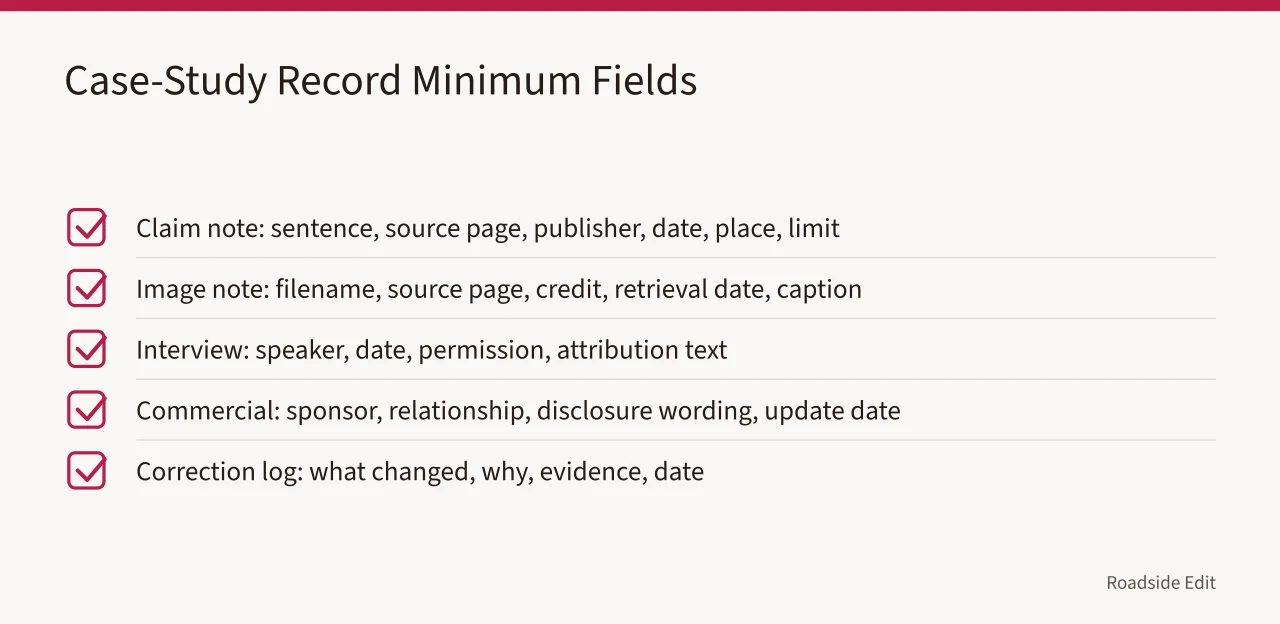
Record type / Minimum fields
- Claim note
- Article sentence, source page, publisher, date, place, source limit
- Image note
- Filename, source page, credit or creator, retrieval date, caption
- Interview or submission
- Speaker or organization, date, permission status, attribution text
- Commercial record
- Sponsor or submitter, relationship, disclosure wording, update date
- Correction log
- What changed, why, evidence checked, date of update
A bare URL explains nothing. Save the page title, the publisher, the publication or review date, and the reason the source was used. Was it the origin of a figure, background, or a pointer to a better record? Label it.
For photographs, keep the actual source page rather than a search result or thumbnail link. The AP Stylebook governs how most US desks style names and titles, but it will not tell you whether a picture was cleared for print. That lives in the image note.
Claim notes and the correction ledger
Every material statement needs a direct source path. Record the sentence, the exact source page, the source date, the date checked, the geographic boundary and any known limit. If a source is only background, label it background.
If a claim rests on a price, keep the amount, the source label, the scope and the exclusions together. A partial figure from a trade report is not a current total, and an editor who loses that distinction publishes a wrong number.
| Change | Record to keep | Public action |
|---|---|---|
| Source revised | Earlier title and new page | Check each dependent claim |
| Historical figure corrected | Original record and correction | Update sentence and date |
| Image source changed | Old and new credit pages | Replace caption and media note |
| Sponsor statement added | Submission and disclosure | Attribute near the claim |
The SEC investor guide to financial statements is written for readers of company accounts, not for editorial files. It still shows why revenue figures need a period and a basis attached, which is the same discipline a case study needs.
Separating reporting from promotion
When a company supplies a profile, a correction or sponsored copy, file it as a business submission. Do not fold it into the research notes. That way the commercial material can be updated without disturbing the independent evidence.
The FTC native advertising guide sets out when sponsored content must be labelled so readers can tell it from editorial. Save the disclosure wording with the profile, price or recommendation it covers. A paid statement may be newsworthy, but it is not independent evidence.
Example: a disputed membership figure
A case study states that a trade body has 4,000 members. The claim note holds the association's annual report, the page number, the year and the note that the count includes lapsed renewals. Two years later the association revises the figure to 3,100.
The editor opens the note, checks the new page, and updates the sentence with the revised number and the year. The correction log records the change, the evidence and the date. The rest of the article stands untouched.
Reviewing the file before publication
Work through this checklist at least once per issue:
- Open every linked source and confirm the publisher, date and scope still match the sentence.
- Confirm each image credit matches the file, the caption and the licence record.
- Check that every sponsor mention carries its disclosure wording.
- Read the correction log and confirm no unresolved question has been quietly dropped.
- Remove private contact details and sensitive operational information from anything that could be published.
If a source disappears, narrow or remove the dependent claim until a specific replacement turns up. A fact-checking case study on a fictional data claim shows how quickly a single unverified number spreads through a feature, and why the note has to exist before the page closes.
The final file should let another editor reconstruct the decision without guessing: what ran, why it ran, what evidence existed then, and which question remains open for a later update.