Guides
How roadside design studios keep case study owner records straight
Roadside design case study records guide for 2027 explains how to retain sources, image credits, claim notes, updates, and disclosures for reliable publication.
A case study should leave enough evidence behind for an editor to correct it later. The working record does not need to expose private notes or sensitive information. It does need to show where consequential claims, images, updates, and disclosures came from.
What to take away
- Store the source page and the exact claim it supports together.
- Keep image credits connected to the local file and published caption.
- Separate provider submissions and sponsorship records from independent research.
- Preserve corrections and unresolved questions as part of the article record.
Create a case-study record
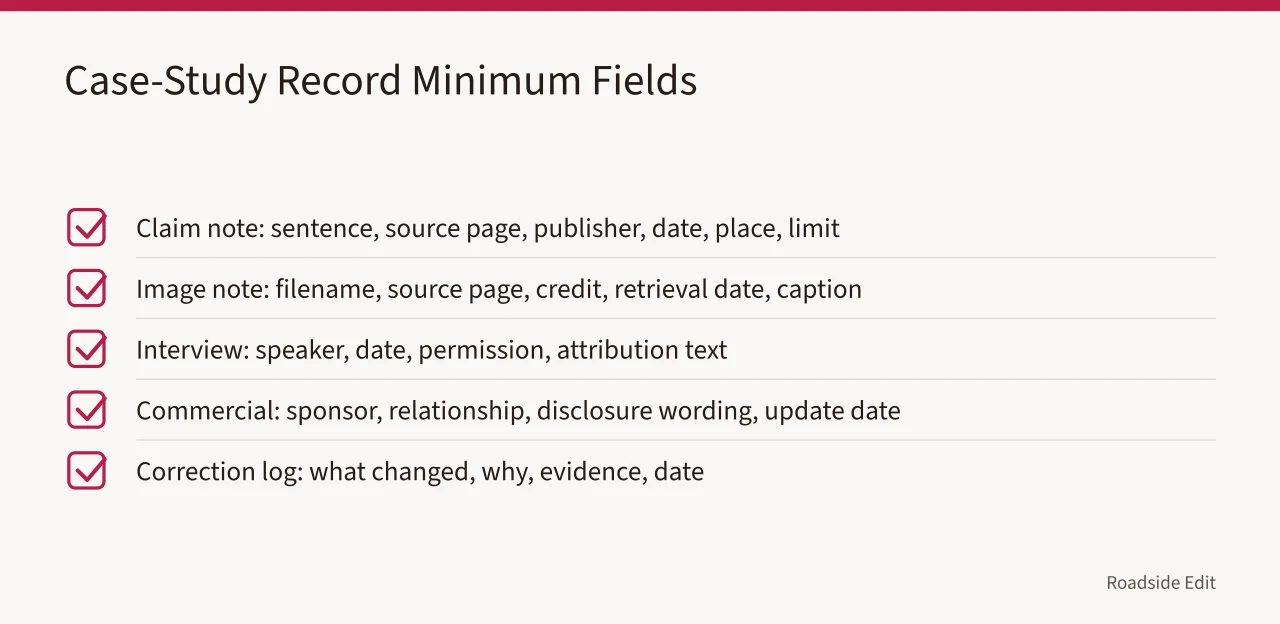
| Record type | Minimum fields |
|---|---|
| Claim note | Article sentence, source page, publisher, date, place, and source limit. |
| Image note | Filename, source page, credit or creator, retrieval date, and caption. |
| Interview or submission | Speaker or organization, date, permission status, and attribution text. |
| Commercial record | Sponsor or submitter, relationship, disclosure wording, and update date. |
| Correction log | What changed, why, evidence checked, and date of the update. |
The National Archives defines conservation as including examination, documentation, and treatment of records, and it notes that treatment documentation helps future caretakers understand what was done. Review NARA's preservation terms. A digital article record is not archival conservation, but the underlying practice transfers well: later editors need a traceable explanation of earlier changes.
Keep sources in context
Save the page title, publisher, publication or review date, and the reason a source was used. A bare URL does not explain whether the page supported a local fact, supplied background, or merely led to a better record. For photographs, retain the actual source page rather than a search page or thumbnail link.
The National Archives explanation of primary sources describes primary sources as firsthand evidence from the period being studied. A dated case-study report, invoice, award notice, or image can document what was recorded then. It should not be carried into a current claim without its original date, place, and scope.
Build a claim and correction ledger
Every material article statement needs a direct source path. Record the sentence, exact source page, source date, date checked, geographic boundary, and known limit. If a source is only background, label it background. If it supports a price, keep the amount, source label, scope, and exclusions together.
| Change | Record to keep | Public action |
|---|---|---|
| Source revised | Earlier title and new page | Check each dependent claim |
| Historical figure corrected | Original record and correction | Update the sentence and date |
| Image source changed | Old and new credit pages | Replace caption and media note |
| Sponsor statement added | Submission and disclosure | Attribute it near the claim |
The GAO Cost Estimating and Assessment Guide says estimates need a purpose, scope, assumptions, data, methods, and updates. It is not a case-study archive standard. It supports retaining the basis of any amount so an editor does not turn a historical or partial figure into a current total.
Separate sources from promotions
If a business supplies a profile, a correction, or sponsored copy, save it as a business submission. Do not merge it into the research notes. This makes it possible to update commercial material without rewriting the independent evidence record, and it makes disclosure clear to readers.
The FTC's endorsement guidance explains that a material connection should be disclosed when it could affect how readers evaluate an endorsement. Save the disclosure wording with the related profile, price, or recommendation. A paid statement may be relevant, but it is not independent evidence.
At each review, open the linked pages, confirm the publisher and scope, and record whether the article still matches them. If a source disappears, narrow or remove the dependent claim until a new specific source is found. Keep private contact information and sensitive operational details out of the public record.
The final file should let another editor reconstruct the decision without guessing: what was published, why it was published, what evidence existed at the time, and which unanswered question clearly remains for a later update responsibly.
Common questions
Should a writer keep every tab opened during research?
No. Keep the pages that support published claims, explain a correction, or credit a visual asset.
How long should a correction record stay with the article?
Keep it for as long as the article is published and may be updated.
What if a source page disappears?
Remove or revise the dependent claim unless another reliable, specific source supports it.