Guides
Vintage diner interiors mistake prevention: a checklist before you publish
Use this 2027 vintage diner interior mistakes checklist to check sources, image dates, contributor relationships, paid placements, limits, and corrections.
This vintage diner interior mistakes checklist helps a writer identify reporting gaps before publication. It is not a care checklist for a physical diner. Use it to check what a source proves, what it leaves open, and how an article labels supplied or paid material.
What to take away
- Start with source, date, place, and relationship.
- Keep historic evidence separate from current claims.
- Disclose payment and contributor roles clearly.
- Preserve substantive corrections in the article record.
Check the claim file
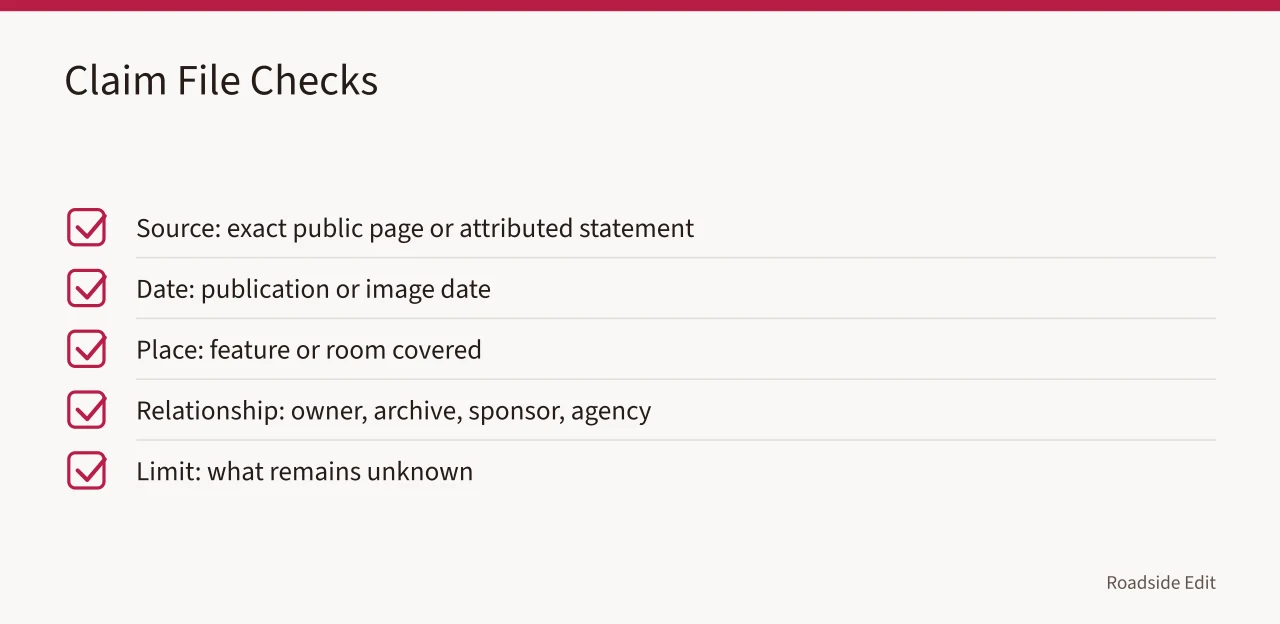
| Check | Include | Avoid |
|---|---|---|
| Source | Exact public page or attributed statement | A general homepage |
| Date | Publication or image date | Present-tense inference |
| Place | Feature or room covered | A claim about all interiors |
| Relationship | Owner, archive, sponsor, agency | Hidden promotion |
| Limit | What remains unknown | A confident guess |
NPS explains that rehabilitation can retain materials, features, and finishes that define historic character while accommodating a new use. Its historic-building reuse article supports a narrow editorial point: an article should identify character-related claims carefully rather than assume every old feature has the same significance. It does not tell a writer how to assess a diner.
Run the checklist before publishing
- Confirm the source supports the exact sentence.
- Identify whether the record is historical, current, or proposed.
- Caption images with their credit and time limit.
- Attribute business-supplied material.
- Label paid listings conspicuously.
- Add a correction route and review date.
If a check fails, narrow the claim or remove it. This is more credible than writing beyond the evidence, especially in a review or listicle where promotional language can look like editorial verification.
Use the same checklist after a correction. A changed sentence can accidentally lose its source, disclosure, or date when it is republished.
Review the title and summary too, because they can overstate a cautious body paragraph.
Keep this review note with the article's source record.
It prevents later edits from losing context.
The National Archives records-management overview supports keeping the source, reviewer, and date behind a published claim. For an editorial checklist, this record helps a later editor trace a factual sentence without claiming that the site reviewed a diner in person.
The Library of Congress primary-source analysis guide separates observation from interpretation and additional research. That method supports checking what an image visibly depicts before using it to support a conclusion about origin, condition, or current status.
The Federal Trade Commission's endorsement guidance supports a clear disclosure when compensation or another relationship could affect how readers evaluate a statement. A disclosure provides context; it does not independently confirm a business submission.
Review wording after the links are added
An article can become less accurate during polishing. A cautious source sentence may acquire a stronger headline, caption, or summary that the source cannot support. Compare each short element with the working record before publication. If a title says "original," "restored," or "best," ask for the specific record that supports that word. Otherwise use a neutral description.
Keep contributor material in a separate editorial note until its status is clear. An owner update can add useful detail, but it should be published as an attributed report unless a suitable independent source confirms the same fact. A payment should remain visible beside a paid placement, not buried in a distant policy page.
Finally, check the correction route. A reader who finds a factual error should be able to identify the claim, provide the relevant source, and understand what the editor will review. This process makes the checklist practical rather than ornamental.
Use the checklist at two moments: after drafting and again after layout. The second pass matters because a caption, pull quote, or page excerpt can carry a stronger claim than the body text.
Confirm the source link sits near the sentence it supports. Keep the photo credit in the figure caption, and place a disclosure where readers see the paid material.
The result is a page with useful detail and clear boundaries. It tells readers what a source records, what a contributor says, and what the publication has not established. That distinction is the best defense against repeated mistakes across related articles.
Common questions
Is a business update an independent source?
No. It can be useful when attributed, dated, and kept distinct from independent evidence.
What should happen to an unsupported detail?
Find a suitable source, narrow the wording, or remove it.
Why is the source date important?
It tells readers whether the information describes a past record or a current report.